
Gianmaria Niccodemi, from the University of Liverpool, uses the Millenium Cohort Study to analyse the relationship between family income trajectories and the development of socio-emotional behavioural problems at age 17.
Adolescence is a key stage of life that shapes health, well-being, and opportunities in adulthood.
In the UK, there are increasing concerns about adolescent development, particularly poor mental health. In 2023, an estimated 23% of adolescents aged 17-19 had a probable mental disorder, and mental illness has been described as one of the modern epidemics of childhood.
In this context, analysing how socio-economic circumstances are linked to mental health difficulties in adolescence is important for policy and prevention.
How we used the Millenium Cohort Study
In our study, we examined how trajectories of family income, from infancy to early adolescence, were associated with a range of poor outcomes by age 17.
To do so, we used data from the Millennium Cohort Study, a UK-representative cohort of children born between September 2000 and January 2002.
The Millennium Cohort Study was particularly valuable for this research, as it provided repeated, detailed measures of family income across childhood, as well as rich, linked health and developmental data in adolescence.
This allowed us to examine how socioeconomic disadvantage accumulated over time and how it was associated with poor outcomes later in life.
The development of socio-emotional behavioural problems by age 17 was one of the main outcomes we examined.
These problems include hyperactivity, conduct problems, and emotional and peer difficulties, which are commonly used indicators of mental health difficulties.
How family income trajectories were linked to socio-emotional behavioural problems at age 17
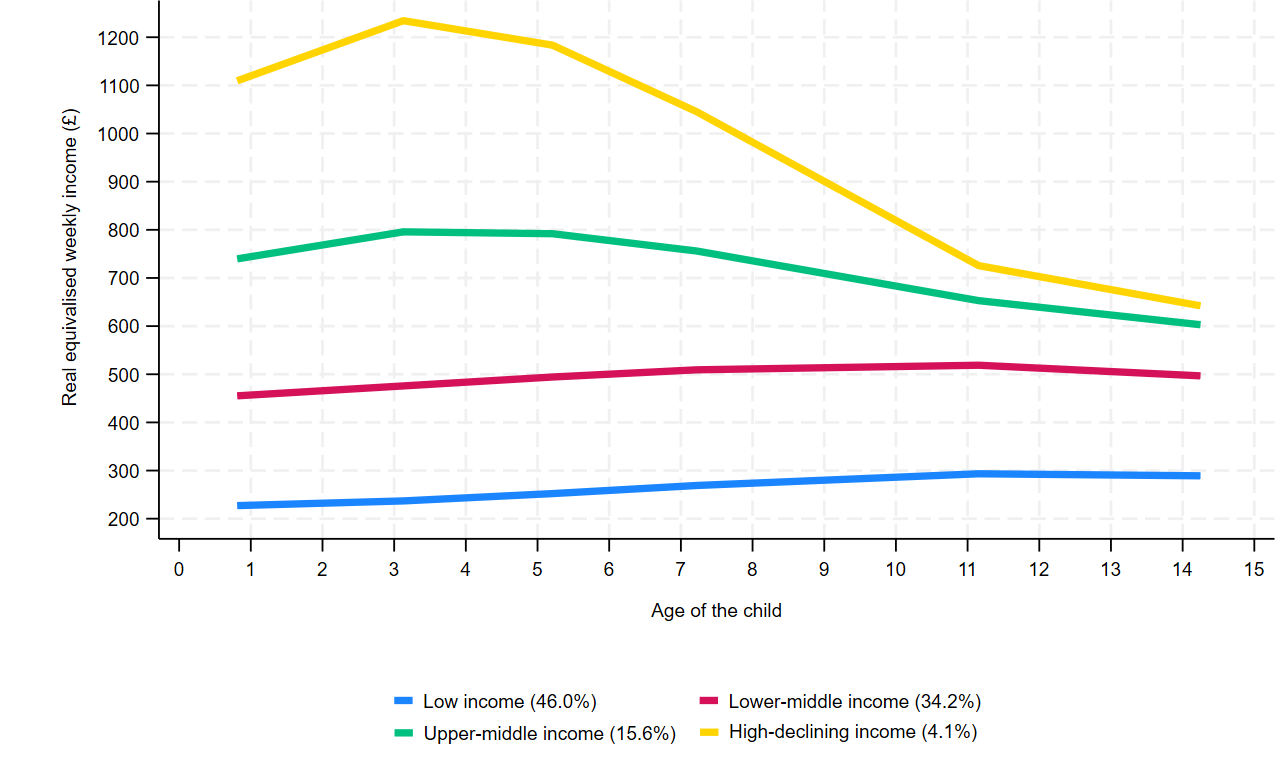
We analysed family income from when children were aged 9 months (2001–2002) to age 14 (2015–2016), adjusting values to 2015 prices.
We identified four possible income trajectories: low, lower-middle, upper-middle, and high-declining. The high-declining trajectory may have reflected the impact of the 2008 financial crisis, which disproportionately affected higher incomes in the UK (before housing costs).
Figure 1 shows income trajectories across childhood, with 46% of the cohort in the lowest-income group.
Figure 1: income trajectories over the age of the child
Simply comparing the prevalence of socio-emotional behavioural problems at age 17 across income-trajectory groups could be misleading. This is because children in different trajectories also differ in early-life characteristics that may affect mental health and development.
To minimise this problem, we used statistical models (logistic regression) to account for a wide range of early-life factors. These included, for instance, maternal education and age, paternal presence and region of residence, which we treated as conditions at birth, measured before income trajectories were observed.
We then estimated the expected percentage of adolescents developing socio-emotional behavioural problems by age 17 under hypothetical scenarios in which the whole cohort was exposed to each income trajectory in turn.
We compared the estimates for the low, lower-middle, and high-declining trajectories with those for the stable upper-middle trajectory.
Figure 2 shows these comparisons.
Figure 2: expected percentage of adolescents with socio-emotional behavioural problems by income trajectory and differences relative to the upper-middle trajectory
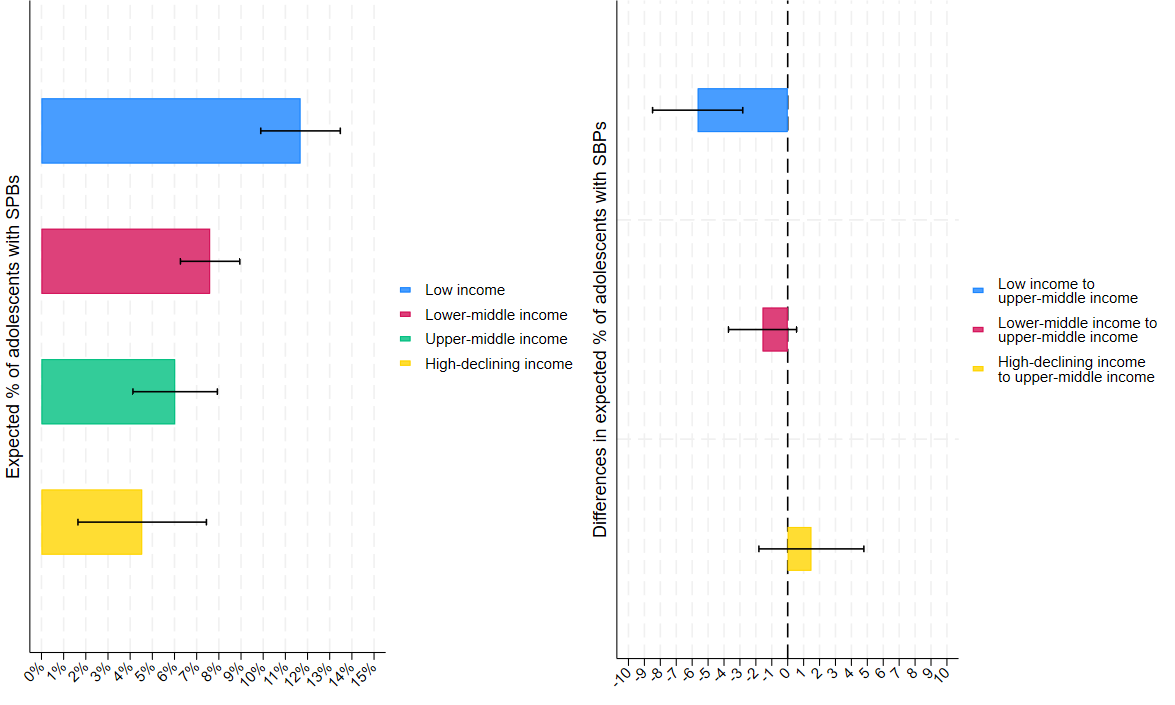
The left panel shows the expected percentage of adolescents developing socio-emotional behavioural problems (SPBs) by age 17 for each income trajectory. The right panel shows how much higher or lower this percentage is compared with the upper-middle trajectory. All estimates are shown with 95% confidence intervals. Larger version / Accessible version.
For example, if the whole cohort had followed the low-income trajectory, the model predicts that nearly 12% would have developed socio-emotional behavioural problems by age 17.
In comparison, the figure for the stable upper-middle trajectory is around 6% – a difference of about 6 percentage points.
The same comparisons can also be expressed as a ratio rather than a difference, with the expected percentage under the low-income trajectory being about twice as high as under the stable upper-middle trajectory.
Figure 3 shows the comparisons expressed as ratios.
Figure 3: expected percentage of adolescents with socio-emotional behavioural problems and ratios relative to the upper-middle trajectory
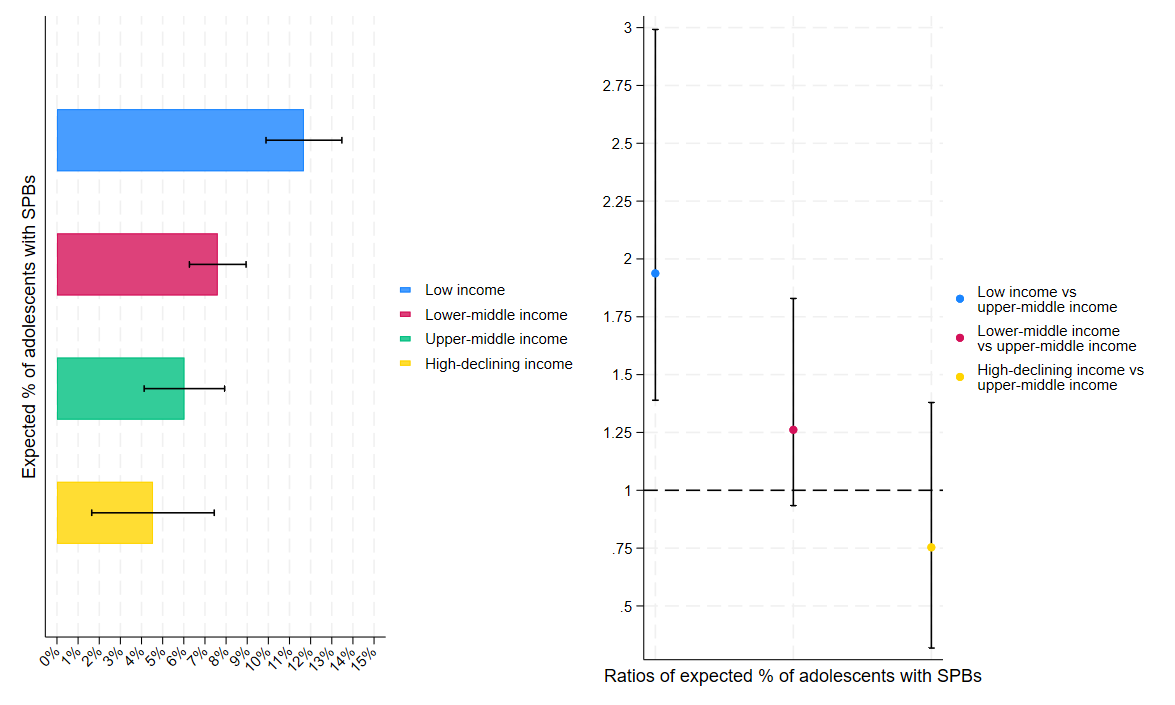
The left panel shows the expected percentage of adolescents developing socio-emotional behavioural problems (SBPs) by age 17 for each income trajectory. The right panel shows the ratio of these percentages relative to the upper-middle trajectory. All estimates are shown with 95% confidence intervals. Larger version / Accessible version.
We also estimated that around 33% of cases of socio-emotional behavioural problems would have been prevented if everyone had followed the stable upper-middle trajectory, a measure known as the Population Attributable Fraction (PAF). The low-income trajectory alone accounts for about 27% of all cases (Figure 4).
Figure 4: population attributable fraction (PAF) if all adolescents had followed the upper-middle trajectory
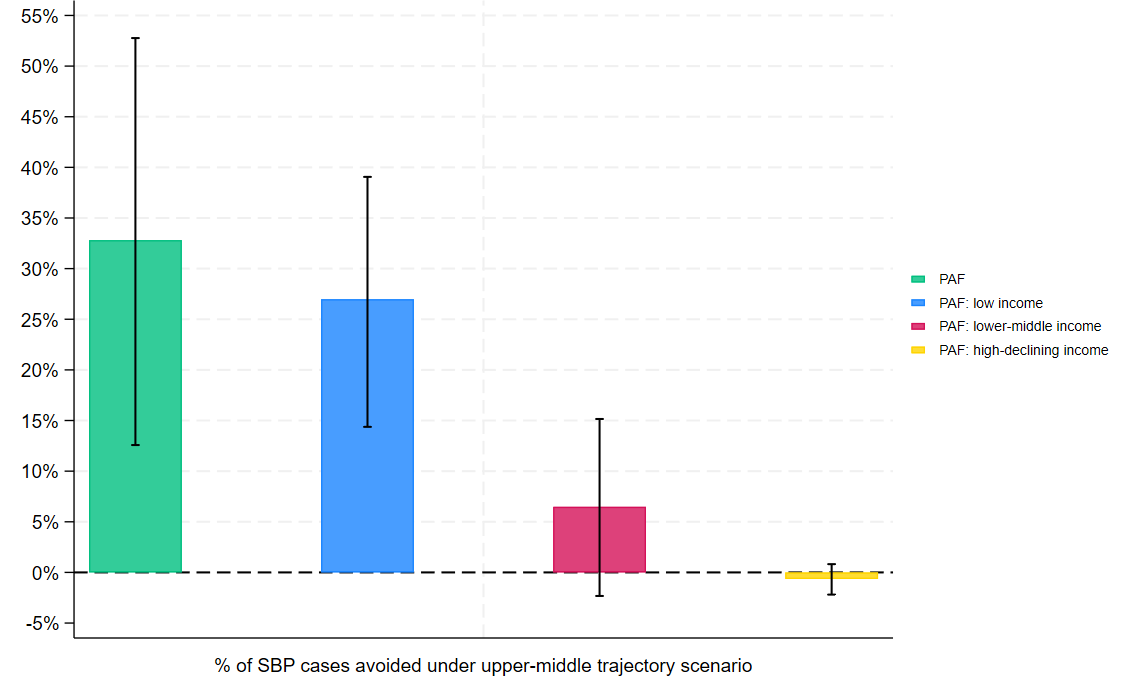
Expected percentage of cases that would have been avoided if everyone had followed the stable upper-middle trajectory (green bar), and the contribution of each income trajectory (blue, red, and yellow bars) to this total. All estimates are shown with 95% confidence intervals. Larger version / Accessible version.
These estimates should be interpreted with caution, as they assume that any important factors not included in the analysis, but plausibly linked to family income – other than factors that may themselves result from postnatal income trajectories – did not explain the differences in mental health outcomes between groups.
Why this matters
Our study finds an association between persistent low income during the first 14 years of life and the occurrence of socio-emotional behavioural problems by age 17.
These results are important in the context of rising mental health challenges among children and adolescents in the UK.
An association between family income trajectories and other poor outcomes was also found, including underachievement in educational qualifications and habitual smoking.
Therefore, our study aims to inform efforts to reduce longstanding socio-economic inequalities in adolescent development and well-being.
Taxation, spending, and welfare policies can be used to raise and sustain the lowest family incomes and to fund universal services that support healthy and holistic development.
At the same time, family income is unlikely to provide a complete explanation; parental, community, and other environmental factors also play an important role in shaping adolescent development.
Research is needed to clarify which combinations of policies and interventions can most effectively reduce health and well-being inequalities among young people.
About the authors
Gianmaria Niccodemi is a postdoctoral researcher at the University of Liverpool, department of Public Health, Policy and Systems.
His research interests include socio-economic determinants of mental health, physical health, and wellbeing.
Comment or question about this blog post?
Please email us!