
 Raysa Rocha examines the experiences of neurodivergent workers in the UK during the data collection process, highlighting the importance of designing inclusive research from the outset.
When we began designing a study on how neurodivergent workers in the UK experience workplace relationships and well-being, we made a deliberate choice: inclusion would not be confined to the research questions alone but embedded in how we collected the data itself.
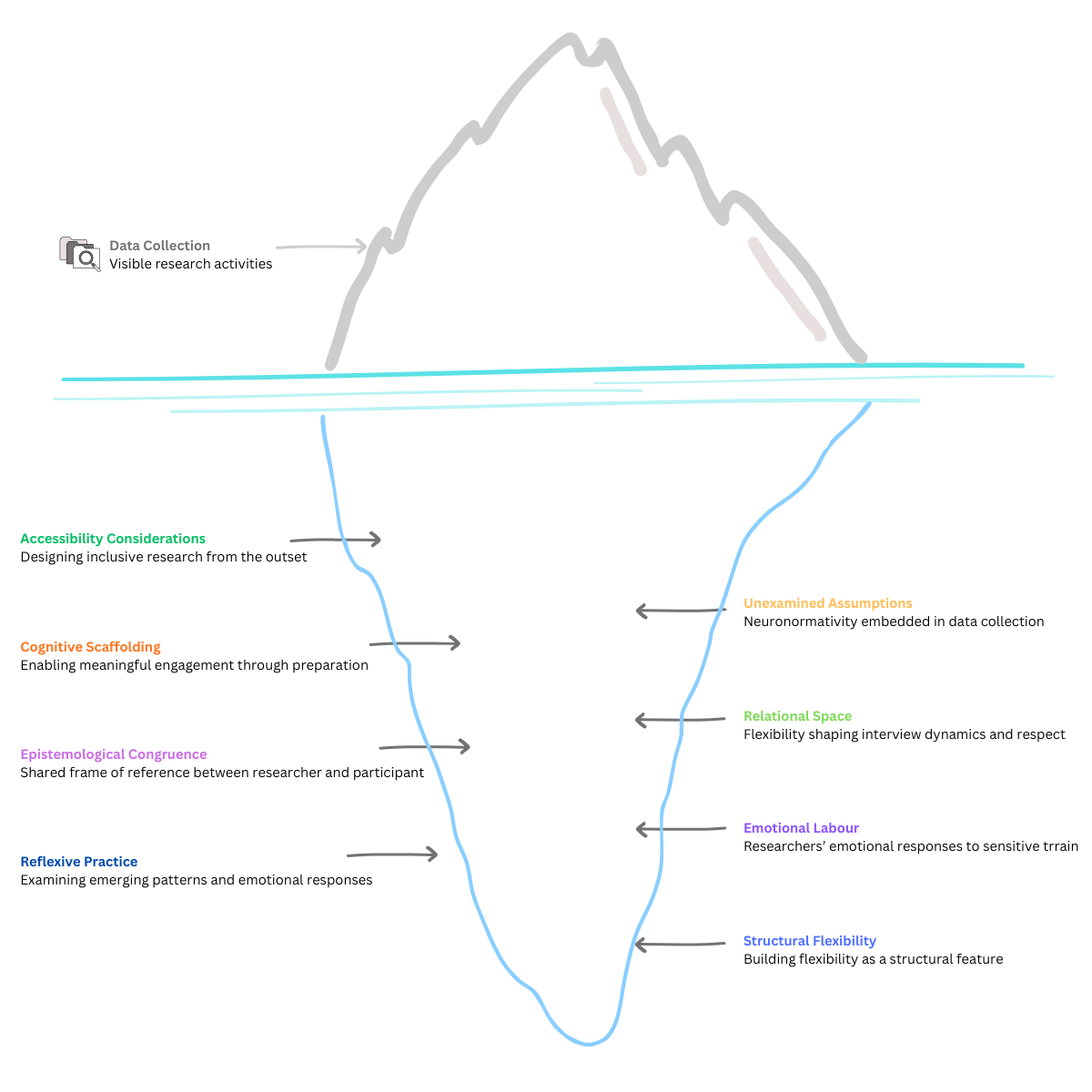
Before conducting 37 in-depth interviews, we built accessibility considerations into every stage of data collection, from recruitment materials and consent processes to interview format, accommodations, and follow-up.
We treated this not as procedural compliance but as a precondition for trustworthy and ethical research with neurodivergent communities.
What we could not have fully anticipated was how much this commitment would also reshape us as researchers, deepening our understanding of what inclusive data collection demands in practice.
This blog reflects on what we learned from that experience, and on the particular methodological and emotional dimensions that arise when neurodivergent researchers collect data with neurodivergent participants.
Designing data collection for inclusion and equity
Good qualitative research practice already emphasises flexibility, rapport, and participant comfort.
Yet even well-designed protocols can carry unexamined assumptions about the ‘ideal participant’: someone who processes information at a predictable pace, follows questions linearly, and navigates scheduling and communication norms with ease.
For neurodivergent participants, these assumptions can create invisible barriers to researchers who do not share those experiences. These assumptions, which are rarely examined, embed neuronormativity into the very architecture of data collection.
For our project, we recognised early that if we wanted authentic accounts of neurodivergent workplace experiences, we needed to dismantle those assumptions at the design stage.
We distributed interview topics, participant information sheets, and consent forms well in advance. This was not merely a courtesy; it was cognitive scaffolding that enabled meaningful engagement.
Participants could process the themes at their own pace, reducing the executive function demands that can make spontaneous interview settings exclusionary.
We offered accommodations as standard rather than upon request: the option to keep cameras off, take breaks, reschedule without stigma, and choose whether to engage via video, audio, or text-based follow-up.
Some of these adjustments were taken up; many were not. Some participants elected camera-off settings. Others navigated domestic interruptions, from phones ringing to pets appearing and household movement, that, rather than compromising data quality, illuminated the authentic realities of neurodivergent professionals working within complex domestic ecosystems.
What distinguished our approach was treating these moments through a neurodivergent lens: recognising, for instance, that a participant’s visible difficulty returning to focus after an interruption was not a failure of engagement but a reflection of executive function differences that the interview design should accommodate rather than penalise.
Crucially, offering accommodations shape the relational space of the interview, even when participants do not use them. The signal of flexibility communicates respect, and respect generates richer data.
Positionality: when the researcher is also neurodivergent
Every interview was conducted collaboratively by two investigators, at least one of whom identified as neurodivergent.
This deliberate design served multiple purposes: it enabled real-time collaborative input through silent communication channels, provided mutual cognitive support during emotionally demanding sessions, and ensured a built-in reflexive check on the evolving dialogue.
While Researcher 1 asked the questions, Researcher 2 was responsible for taking notes and prompting Researcher 1 with additional questions, clarifications, and returning to the research topics as needed.
For us, this insider positioning created epistemological congruence, a shared frame of reference between researcher and participant that traditional methodological training rarely acknowledges.
This congruence brought extraordinary depth to the interviews, but it also carried emotional weight. Participants’ workplace narratives frequently traversed sensitive terrain: experiences of exclusion, misunderstanding, and masking. Some interviewees were moved to tears.
In those moments, the researchers’ own experience of navigating similar workplace challenges enabled a particular quality of recognition. This was not automatic, nor would we claim that shared neurodivergence guarantees rapport; neurodivergent experiences are far too heterogeneous for such a generalisation.
Rather, it was our specific familiarity with the dynamics participants described, the masking, the sensory management, the social cost of disclosure, that allowed us to hear their accounts with a depth of understanding we might not otherwise have accessed.
These were not just data collection episodes. They became spaces of mutual recognition and shared understanding.
Yet this empathetic depth demands careful reflexive practice. We found that the intersection of researchers’ and participants’ neurodivergence created both methodological richness and analytical complexity.
The note-taking researcher periodically encountered challenges with focus and attention when the interview pace slowed, challenges that, while not unique to neurodivergent researchers, were amplified by the attentional profiles we brought to the work.
Researchers occasionally arrived a few minutes late. Participants sometimes forgot questions or embarked on tangential narratives, requiring gentle redirection from the second investigator.
Rather than treating these moments as methodological failures, we recognised them as data in themselves: authentic expressions of neurodivergent experience that deepened, rather than compromised, our reflexive depth.
The researcher’s emotional labour of inclusive research
Methodological literature devotes extensive attention to participant well-being, and rightly so. Far less is written about researcher positionality in the sense of what happens to the researcher when lived experience and professional identity converge in the interview space.
All qualitative researchers experience some degree of personal identification with participants’ accounts. For neurodivergent researchers collecting data on neurodivergent experiences, however, this identification can operate with particular specificity and intensity, because the phenomena described, sensory overwhelm, masking, and social exhaustion, are not abstract concepts but lived realities the researcher navigates daily.
We addressed this through structured debriefing sessions immediately after each of the first ten interviews, and after others when the content was particularly novel or affecting, creating reflexive checkpoints to examine emerging patterns and to attend to our own emotional responses.
Methodologically, these sessions allowed us to refine our inquiry as themes developed, for instance, by introducing questions about meaningful work after early interviews surfaced its importance.
Emotionally, they gave us space to process what we had heard before returning to the data as analysts, ensuring that the empathy we brought to each interview remained a source of interpretive depth.
Accessibility as a principle, not a checklist
Our experience carries implications well beyond neurodiversity research. Across the social sciences, data collection methods continue to privilege certain cognitive styles, communication preferences, and social norms.
For example, timed surveys penalise slower processors. In-person focus groups disadvantage those with social anxiety or sensory sensitivities. Consent forms written in dense legalistic prose exclude participants with literacy-related neurodivergences such as dyslexia.
Genuine equality, diversity, and inclusion in data collection requires more than offering adjustments reactively.
It means designing research protocols that anticipate cognitive and sensory diversity from the outset. It means recognising that the temporal rhythms of research, including rigid scheduling, prompt starts, and linear questioning, encode assumptions about ‘normal’ participation that exclude many potential contributors.
And it means building flexibility not as an exception, but as a structural feature of how we gather evidence about the social world.
Figure 1: visualisation of data collection when considering the neurodivergence of both participant and researcher.
What we would tell other researchers
If there is a single insight we would share, it is this: accessibility in research design is not about lowering standards.
It is about removing barriers that prevent data from being collected in the first place. When participants feel safe, respected, and genuinely accommodated, the quality and depth of what they share increases dramatically.
Our 37 interviews produced over 30 hours of recordings and more than 1,500 pages of transcribed data that will be stored by the UK Data Service after the conclusion of our project. We attribute this richness directly to the inclusive architecture of our data collection process.
We would also encourage research teams to reflect carefully on the emotional dimensions of insider research.
Neurodivergent researchers bring irreplaceable insight to studies of neurodivergent experience, but this positioning requires institutional support: dedicated debriefing time, recognition of the emotional labour involved, and research cultures that value reflexivity as a form of rigour rather than a footnote.
Data shapes policy, practice, and the narratives that shape how communities are understood.
If the process of collecting that data excludes or marginalises the very people it concerns, then our evidence base is fundamentally compromised. Inclusive data collection is not a methodological luxury; it is a condition of good science.
Meet the author
Dr Raysa Rocha, University of Essex, is the Principal Investigator on the research project examining how neurodivergent workers in the UK experience workplace relationships and well-being (funded by the British Academy/Leverhulme Small Research Grants (Award Reference: SRG24\241480), derived from the Academy’s partnership with the Wellcome Trust).
Her research team includes Dr Louise Nash (University of Essex) and Dr Siddhartha Saxena (Heriot-Watt University). The project combines quantitative analysis with qualitative interviews to develop evidence-based strategies for neuroinclusive workplaces.
Follow Raysa on LinkedIn.
Comment or question about this blog post?
Please email us!