
Corine Driessens, Methods & Analytics Lead at ARC Wessex, worked with YoungMinds, young people, and statistical expert Peter Smith to identify the characteristics of the ‘missing middle’, young people experiencing mental health problems but not accessing services, using the Next Steps cohort.
Why do the majority of young people with mental health needs never walk through a clinic door?
This “missing middle” represents a vast group we know surprisingly little about. In our study, we didn’t just analyse outcomes, we rethought how secondary data research can be done.
Using a co‑design approach, young people partnered with us to adapt ‘Andersen’s Behavioral Model of Health Care Utilization’ to reflect their lived realities. We then analysed the Next Steps cohort through this youth‑informed lens.
In this blog post, I pull back the curtain on this collaborative process, and what it reveals about who accesses support, and who is left behind.
The 2022 baseline: known and unknowns

Over the past two decades, mental health problems among young people increased from 1 in 10 to 1 in 4, yet most did not use mental health services.
Service use is shaped by social, economic and systemic factors, as well as hesitancy among healthcare professionals to formally diagnose mental health conditions.
Young people who experience mental health symptoms but don’t access services are known as the “missing middle”. Limited understanding of their experiences makes it harder to provide the support they need.
Psychological distress is common
10% experienced symptoms at age 14, 16 and 25.
26% experienced symptoms at two age points.
31% experienced symptoms at one age point.
Mental health service use is low in young people
1.8% accessed services before age 17.
6.8% accessed services between ages 17 – 25.
Project aim
Identifying the characteristics, needs and support preferences of the missing middle
Our approach
Listening, analysing and feeding back.
Step 1: listening & co-production

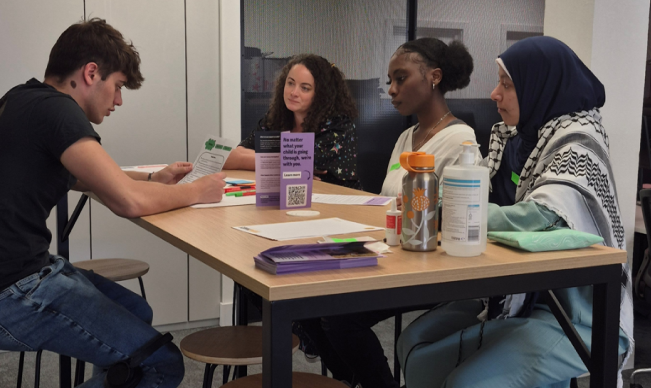
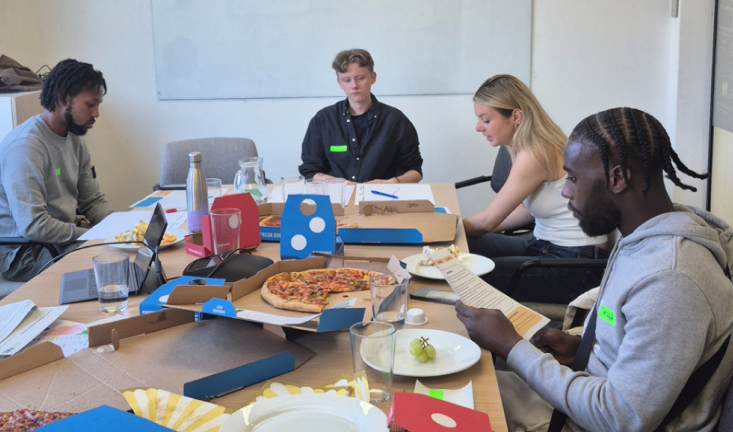
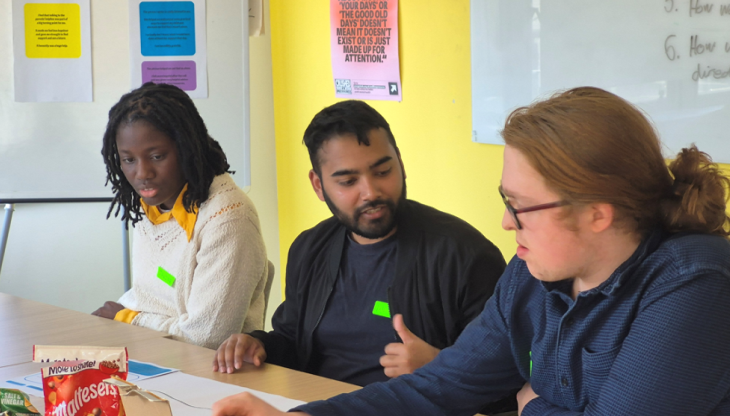
Through interactive workshops and reflection, young people from the “missing middle” co-produced a data analysis plan with four interconnected pieces: mental health service use, predisposing factors, need, and enabling factors. Together, these formed an analytic lens through which the Next Steps cohort data were examined.
Step 2: Analysing NEXT STEPS
 Logistic regression explored how factors before age 17 predicted service use recorded in health records between ages 17 – 25.
Full findings are discussed in the report paper.
Key findings include:
- Mental health service use was most strongly driven by evaluated need
- Diagnosis before age 17 was the strongest predictor of use (ages 17 – 25)
- Higher likelihood of use was also linked to long-term conditions, disability and number of hospital admissions
The wider implications of these findings are that capacity constraints within mental health services have increasingly shifted responsibilities to professionals in education and primary care.
Step 3: feeding back into practice
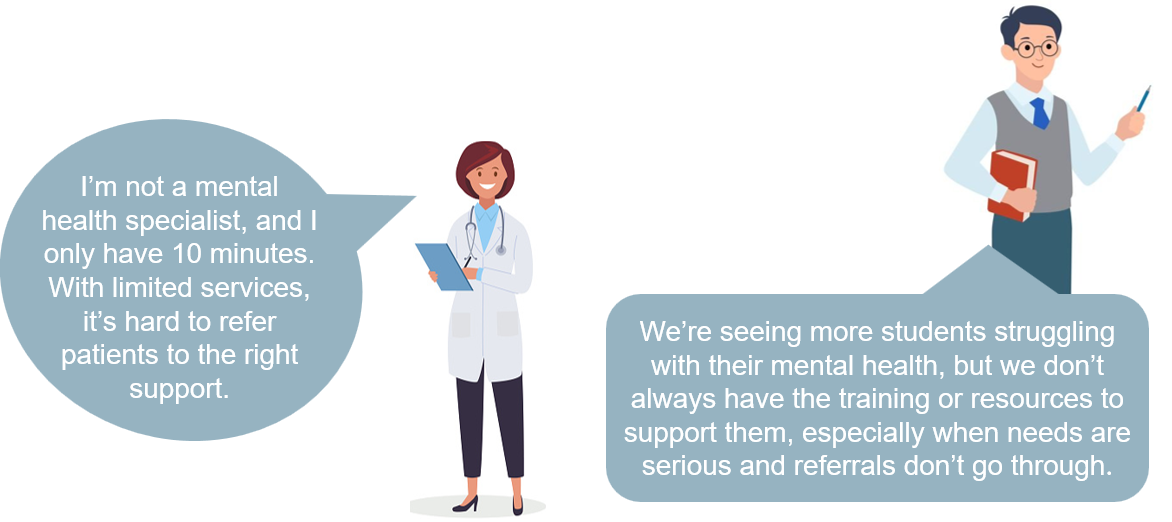
We discussed results with GPs and teachers to understand real-world constraints and implications.
GPs said:
“I’m not a mental health specialist, and I only have 10 minutes. With limited services, it’s hard to refer patients to the right support.”
Teachers said:
“We’re seeing more students struggling with their mental health, but we don’t always have the training or resources to support them, especially when needs are serious and referrals don’t go through.”
What young people from the missing middle told us would help
Three critical shifts are needed to better support the missing middle.
Support needs to be in spaces we would feel safe going to
- To better support LGBTQIA+ students, dedicated spaces and inclusive accommodation should be provided
- Apprenticeship guidance should ensure mentors prioritise apprentices’ wellbeing and social integration
Teachers and GPs don’t really know what to do with mental health
- Build well-resourced community hubs where young people, regardless of background, can connect, find safety, take part in activities and receive mental health support
- Mental health training for all health professionals and staff in educational settings to deepen and broaden understanding
You have to be really bad before anyone will help
- Make mental health support easier to find through clear pathways, better awareness and support beyond specialists
- Recognise and support young carers earlier, through improved benefits and better awareness of available support
- Teach children and young people emotional literacy and coping techniques
What we took from what young people told us
From clinical-first to community-led support
From referral dependence to validated everyday support
From high threshold to low-barrier access
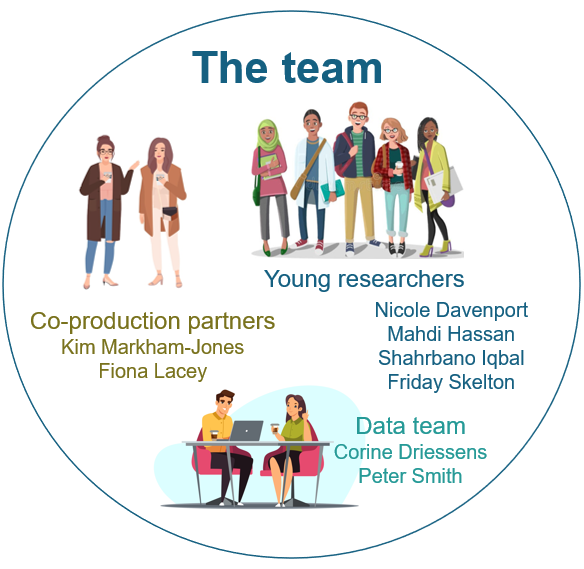
The team
This work was made possible through UK data infrastructure and collaboration across research, practice and lived experience.
Co-production and lived-experience partner:
Data and research infrastructure partners:
Redefining support
Our findings challenge the assumption that no service use means no need. By working alongside young people, we show that many barriers faced by the missing middle are systemic rather than personal. The goal is not simply to increase service numbers, but to build a support ecosystem that young people actually want to use, one that intervenes earlier, outside clinical settings, and before crisis point.
About the author
Corine Driessens is Methods & Analytics Lead at ARC Wessex, University of Southampton, where she provides methodological expertise across a diverse portfolio of projects.
Her research focuses on children and young people’s mental health and wellbeing. She has a particular interest in mixed methods research, including longitudinal data analysis, linked cohort data, and the impact of missing data on cohort studies. Corine is committed to ensuring that participant experience informs her work and integrates patient and public involvement and engagement (PPIE) throughout all stages of the research process.
Comment or question about this blog post?
Please email us!