

The UK Data Service impact team invites researchers, policymakers, analysts, practitioners and others working with data to write for the Data Impact blog.
We welcome fresh voices, new perspectives and compelling stories connecting data to real-world change. Whether you are a seasoned researcher, student, or someone working with data in government, civil society, or community settings – we want to hear from you.
What is the Data Impact blog?
The Data Impact blog is a platform from the UK Data Service that showcases how social, population and economic data, including that held by the UK Data Service, can create meaningful impact and benefits across society.
It is a space where contributors can explore how data informs decision-making, supports communities, advances research and influences policy.
We invite voices from across the data landscape from a wide variety of backgrounds – academic; international, national and local governments; think tanks, charities and foundations; communities and others – to contribute to our blog posts.
Our goal is to inspire, inform and connect a wide audience, raising the profile of data-driven impact and showcasing stories that reflect the richness of the data community. We are committed to amplifying diverse voices and actively welcome contributors from underrepresented groups.
What kinds of contributions are we looking for?
We welcome a range of post types that highlight the impact of data or spark conversations about data. You could write about:
Impact stories
As a blog dedicated to impact, we love to share examples of how data-enhanced research has influenced decisions, policy, practice or community action.
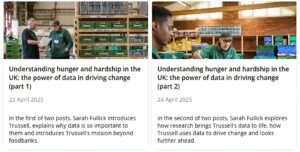
Take our blog posts authored by Sarah Fullick, head of Impact and Evidence at the Trussell Trust, discussing the role of data in both exposing and confronting urgent social issues around hunger and hardship in the UK.
In this two-part post, she explores how Trussell uses data to drive change and inform UK policy recommendations.
Reflections
We are also a resource for researchers who are on their impact journey. So, we encourage you to share what you have learned from using or sharing data including challenges you have overcome or barriers you have faced.
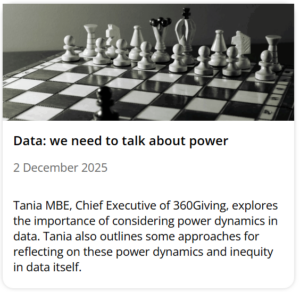
For example, Tania Cohen MBE, Chief Executive of 360Giving, discusses the importance of reflecting on the power dynamics in data in her powerful blog post.
Our Data Impact Fellows also regularly share their personal experiences of working in sensitive areas of research, expanding their knowledge through travel, and what a “day in the life” of a early career researcher looks like.
Insights
Part of our role as the UK Data Service is to contribute to topical conversations about data. That means if you have commentary on trends, emerging issues or ethical questions in data use, we want to hear from you.
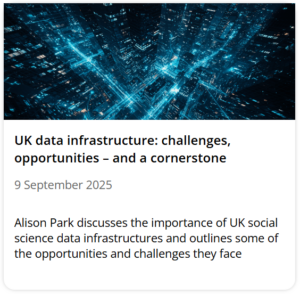
To see what this looks like in practice, read our blog post by Professor Alison Park from the Economic and Social Research Council.
Alison explores the importance of the UK social science data infrastructures and outlines some of the opportunities and challenges that they face in the future.
Collaborations
Research impact doesn’t happen relying on data alone. We also want to celebrate examples of co-production, partnerships or interdisciplinary projects involving data.
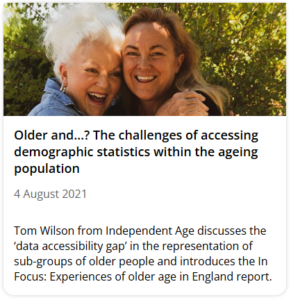
For example, Tom Wilson, from Independent Age, discusses the ‘data accessibility gap’ in the representation of sub-groups of older people in England in his Data Impact blog.
This research was underpinned by co-production groups who had input into key decisions throughout the project, a reminder of the voices behind the data.
Innovation and methods
Innovation drives research, which in-turn generates impact. If you have done something new with data – through research methods, communicating your findings, or improving access to data – we want to share it.
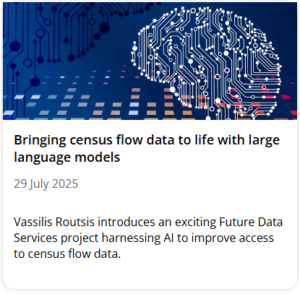
An inspiring example of this is our blog post by Vassilis Routsis, a Senior Research Fellow at University College London.
Vassilis introduces an exciting Future Data Services project exploring how advancements in Large Language Models can enhance the experience of users accessing census flow data through the UK Data Service, making complex datasets more accessible to researchers and policymakers.
How can I contribute to the Data Impact blog
We are always looking for engaging, accessible stories that highlight the impact of data or spark conversations about data. If you have an idea you would like to share, the best way to get it started is to get in touch with us early so that we can shape it together.
Step 1: Pitch your idea
Email us at ukdsimpact@jisc.ac.uk with a short outline of your proposed post.
It is better to approach us with a specific idea than an already-written piece as it will help us to work together to shape something that reflects what you want to share as well as being accessible to readers of the blog.
Step 2: Draft your post
Once we have agreed a topic and a timescale, write and send us your draft, including:
- A short author bio (2-3 sentences).
- A headshot photograph (150 x 150 pixels).
- Any relevant social media handles (e.g., LinkedIn or BlueSky) or a website that you would like.
Additional tips:
- High quality images help attract readers and boost engagement on social media.
- You are welcome to include graphs, charts or figures – where possible, share source data so that we can make it available separately for accessibility purposes.
- Ensure images are either your own or available under a Creative Commons licence (with attribution).
- If you don’t provide us with a featured image (used to introduce and preview your post) we can source one for you.
We are happy to offer feedback as you develop your piece.
Step 3: Editing and review
All submitted drafts will go through a light editorial review focused on clarity, accessibility and reader engagement. We may:
- Add an introductory paragraph for context.
- Adjust length or suggest splitting longer posts into multiple parts.
- Recommend edits to enhance flow or readability.
Your voice and perspective are the most important parts of the post. No edits are compulsory – we will always share any suggested changes with you, and you will have full opportunity to review, discuss and approve them before publication.
Step 4: Publication and licensing
Once finalised and approved, your post will be published under a Creative Commons Creative Commons CC BY-ND 4.0 License, meaning it can be reshared with attribution, but others do not have the right to alter your material. You also will always retain the right to withdraw your article at any point.
We will also promote your post through the UK Data Service’s channels, and you are encouraged to share it through your own networks too.
Format and technical style expectations
We aim to make all posts accessible, readable and engaging. To help your piece shine:
- Aim for 800 – 1200 words, although shorter (500 words) or longer (up to 1500) pieces are welcome if well-focused.
- Use clear, plain English and avoid unnecessary jargon.
- Keep paragraphs short – ideally 3-5 sentences.
- Start with your headline points in the first paragraph to hook readers.
- Think of your post as a story or journey, not just a description – what happened, what changed and what was learned?
- Highlight what is new, interesting or impactful about your work.
- Use headings, bullet points and short sections for readability.
- Write for a broad audience beyond your field.
- Reference other materials by linking directly to open-access sources, datasets or web pages. Use short, descriptive hyperlinks rather than formal citations and avoid links behind paywalls where possible.
- Attribute all images, quotes or data sources clearly.
We follow an inclusive language approach and may gently suggest changes to align with the UK Data Service style.
We are always open to new ideas and approaches. If you have a concept that is different from our usual posts – for example, a creative format, dialogue or visual piece – please let us know. We are happy to explore more innovative ways of sharing data impact stories.
Typical timeline and turnaround
- Response to your pitch: within 1 week
- Editorial review of your draft submission: 2-4 weeks
- Final revisions before publication: 1-2 weeks
The typical process typically takes 4-8 weeks, depending on topic and schedule. We also can adjust the publication schedule to correspond and promote with any of your upcoming work.
So, why contribute?
Contributing to the Data Impact blog is a chance to share your work, insights and experiences with a broad audience. It is an opportunity to raise the profile of your research, organisation or project, inspire others working with data and build your own writing and communication skills.
By sharing your story, you become part of a growing community of data storytellers, helping to show the real-world difference that social, population and economic data can make.
If you have a story that connects data to people, policy or practice – we would love to hear it.
Get in touch: ukdsimpact@jisc.ac.uk
Meet the team



(Left) Finn Dymond-Green (They/Them) is the Director of Impact at the UK Data Service.
(Middle) Eve Little (She/Her) is one of the Impact and Engagement Managers at the UK Data Service.
(Right) Sophie Gawryla (She/Her) is one of the Impact and Engagement Managers at the UK Data Service.
Comment or question about this blog post?
Please email us!