
 Dr Chris Playford, from the University of Exeter, uses Next Steps data to explore how growing up in rural and coastal areas of England shapes young people’s chances of entering managerial and professional occupations at age 25, and the role that moving region plays in those outcomes.
There is a growing interest in understanding regional disparities in social mobility in the UK. Less is understood though about the local context, labour market opportunities or characteristics of the areas that might help explain these patterns.
Separately, it has been recognised that young people living in rural and coastal areas face different challenges to those living in major UK cities, particularly London.
Qualitative work has identified that young people in coastal areas face difficult decisions about whether to move or stay in light of these challenges.
Our study sought to understand the occupational destinations of young people at age 25 in England by including the geographical characteristics of the area in which they grew up, with a focus on urban coastal areas.
Alongside measures of socioeconomic background and educational attainment, the analyses also included information on whether they had moved region and the availability of service class employment in the area in which the young person lived at age 25.
Which data and methods were used?
The analysis was based on the Longitudinal Study of Young People in England, also called Next Steps.
This is a representative cohort study of 15,770 young people aged 13/14 in England in 2004 and includes information on participants up to the age of 25 in 2016 (at the time the analysis was conducted). Previous work exploring progression to Higher Education used the same data.
Three further linkages made the analysis possible:
- Educational attainment in General Certificate of Secondary Education (GCSE) qualifications at age 15/16 is available with linked National Pupil Database data.
- Geographical characteristics of the local area in which the young person grew up at age 14, including region and area-level deprivation, are included as supplementary files with identifiers for the Lower Super Output Area.
- Further information on the distance of the LSOA to the nearest coast.
This enabled us to derive a measure that classified whether the young person grew up in an urban inland, urban coastal, rural inland or rural coastal area. We were then able to estimate logistic regression models adjusting for complex survey design which included geographical and individual-level predictors.
What we found
Young people who grew up in urban coastal areas were less likely to work in a higher managerial, administrative or professional occupation at age 25 than those who lived in urban inland areas.
This remained the case once we controlled for area level characteristics (such as the level of deprivation), individual circumstances (such as parental social class), educational attainment and the availability of advantaged jobs in the local area.
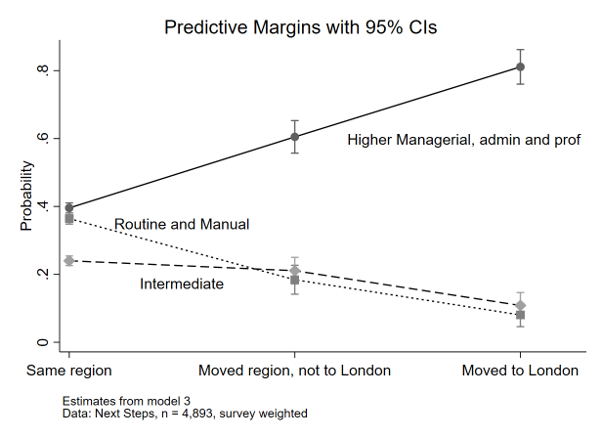
Moving region between ages 14 and age 25 was strongly associated with a higher probability of employment in a higher managerial, administrative or professional occupation.
This is shown in Figure 1 using predictive margins. The predicted probabilities of service class employment were higher for young people who moved region, and higher still for those who moved to London.
Figure 1 – Predictive margins of social class at age 25 by whether young person moved region
Larger version / Accessible version
The final part of our analyses explored the characteristics of those who moved region. This was socially stratified, with the educational attainment of young people, the educational attainment of their parents and the social class of their parents all being associated with moving region.
Young people from urban coastal areas were no more likely to move region than those from urban inland areas after adjusting for socioeconomic background and other area-level characteristics. In contrast, those who grew up in rural inland areas were more likely to move region.
What are the implications?
Our research emphasised the importance of geographic mobility and immobility in understanding occupational outcomes for young people early in their careers.
This was particularly striking among young people who grew up in urban coastal areas and was not explained by the deprivation of their local area or their socioeconomic backgrounds.
Whilst we controlled for the availability of managerial and professional occupations in the Travel to Work Area (TTWA) in which the young person lived at age 25, this is a basic measure and cannot fully capture the complexity of the decision-making process for young people and the job opportunities they perceive to be available to them.
It was very clear though that moving region was strongly associated with leaving behind the characteristics of the place where young people grew up.
This raised a broader question: should young people have to move to work in managerial and professional jobs?
There is a tendency to assume (among people working in managerial and professional jobs) that because of the relative advantaged nature of those working in these occupations that this is the preferred option of young people.
In practice, there may be a much wider set of considerations that young people are thinking about when making choices about their future.
What this work shows is that these decisions are not completely free from the wider set of structural conditions that constrain or present opportunities for young people in the places they grow up.
Meet the author
Dr Chris Playford is a quantitative sociologist working in the fields of social stratification and the sociology of education.
His research explores the role of family background on educational attainment and employment outcomes with a substantive interest in inequality and disadvantage.
Connect with Chris on LinkedIn.
Comment or question about this blog post?
Please email us!