
 Sophie Gawryla, Research Impact and Engagement Manager, highlights the significance of the UK Government’s seventh carbon budget and the role that data accessed through the UK Data Service played in shaping the evidence behind it.
In 2019, the UK became the first major economy to adopt a legally binding net zero target into law, committing to reduce net greenhouse gas emissions by 100% from 1990 levels by 2050.
A “net zero” target means balancing the greenhouse gases we emit with those we remove from the atmosphere. In practice, this means reducing emissions as much as possible and then supporting carbon capture projects to offset any unavoidable greenhouse gases that are still emitted.
Since setting this target, the UK has made steady progress—most notably a rapid shift away from fossil fuels and towards cleaner power, which helped the UK become the first major economy to halve its emissions between 1990 and 2022.
But the reality is that many of these early gains came from sectors where change was easiest to deliver, and what lies ahead is much more complex.
What is a carbon budget?
A key part of addressing this challenge is the requirement—set out in the Climate Change Act 2008—for the UK Government to legislate a series of carbon budgets that legally cap the maximum emissions the UK produces over a five-year period.
Each budget is set twelve years in advance, with the aim of gradually reducing the UK’s emissions over time. They are important because new policy must be designed in a way that keeps the UK on target to meet these future emission limits.
This week, the UK Government announced that the seventh carbon budget will be 535 million tonnes of carbon dioxide equivalent (MtCO₂e) over the five-year period of 2038 to 2042. In other words, the UK has committed to ensuring its total emissions across this five-year period do not exceed this amount.
To put this into perspective, 535 MtCO₂e is equivalent to the greenhouse gas emissions produced by approximately 113 million petrol cars driven for one year. Given that there are nearly 35 million registered cars in the UK, this is clearly an ambitious target for the UK as a whole.
This seventh carbon budget is particularly important because it sets emissions targets for just eight years before 2050, which is when UK Government has committed to achieving net zero.
Calculating the seventh carbon budget
The Climate Change Committee (CCC) is an independent body that advises the UK Government on its progress towards meeting its carbon budgets. Part of this role involves recommending an ambitious, but achievable, target for the next carbon budget.
After the earlier successes in emissions reduction, there are sectors where further emission reductions will be more challenging.
Take buildings, for example: the buildings in which we live are responsible for 23% of the UK’s total greenhouse gas emissions in 2019. Residential homes were responsible for over 77% emissions directly produced by these buildings, mainly due to a reliance on fossil fuels for heating.
Unlike the energy sector, where a few major policy decisions can transform the landscape, progress in this area therefore depends on millions of us making millions of individual choices.
However, the way we decide to heat, insulate and renovate our homes—and how much energy is required to do so—is largely guided by the type of house we live in. That means understanding and incorporating the characteristics of the current UK housing stock is an important part of any emissions model.
Building a deeper understanding of housing stock using housing archetypes
The fact that not all homes use energy in the same way explains why the Climate Change Committee (CCC) commissioned Kamma Climate to create a detailed picture of how UK homes, and how they use energy, differ from each other.
This detailed account of the UK housing stock would then feed into the model used by the CCC to inform its recommendations for the seventh carbon budget.
To do this, Kamma Climate created a dataset of housing archetypes. Each archetype is a group of UK homes that share similar features, for example:
- Region
- Property size
- Tenure
- Energy use
- Heating systems
- Energy saving measures
- Fuel poverty status
This level of detail captures the variation in how homes use energy, resulting in a more realistic model.
Much of this information is available through Energy Performance Certificates (EPCs), which are legally mandated documents outlining the energy efficiency of a building.
But there are gaps in this data Kamma Climate needed to address. For example, information on fuel poverty or the presence of hot water cylinders as heating measures are absent in EPCs.
Where the UK Data Service contributed
To both fill these gaps and validate the existing data, Kamma Climate drew on a wide range of national housing surveys accessed via the UK Data Service:
- English Housing Survey, 2019: Housing Stock Data
- English Housing Survey, 2020-2021: Household Data
- English Housing Survey: Fuel Poverty Dataset, 2019
- Welsh Housing Conditions Survey, 2017-2018
- Scottish House Condition Survey, 2012-2019
- Northern Ireland House Condition Survey, 2016
The dataset created by blending EPC data with these housing survey datasets was then analysed using a hierarchal clustering technique. This allowed the researchers to group homes with similar characteristics, which resulted in 11,657 UK residential housing archetypes. Each home in the UK sits within one of these archetypes.
In their recommendations for the seventh carbon budget, the CCC assumed that the heating systems used by each of these archetypes would, in the absence of any additional energy saving measures, remain relatively stable.
As a result, the emissions calculated for each housing archetype between now and 2050 formed a baseline emissions pathway for greenhouse gases emitted by residential housing—providing we did nothing more to curb our residential energy usage.
The CCC used a range of other in-house or commissioned models to develop baselines for other sectors, including agriculture, aviation, land use and transport. Each of these sector baselines were used in their model to calculate an overall hypothetical emissions pathway that would occur if the UK Government took no further climate action.
Modelling through to recommendation
This was then used to compare alternative scenarios where energy saving measures had been implemented. Figure 1 shows the comparison between the overall baseline (the dashed line) and the pathway recommended by the CCC in the seventh carbon budget.
Figure 1: comparison between baseline UK emissions and the pathway recommended for the seventh carbon budget
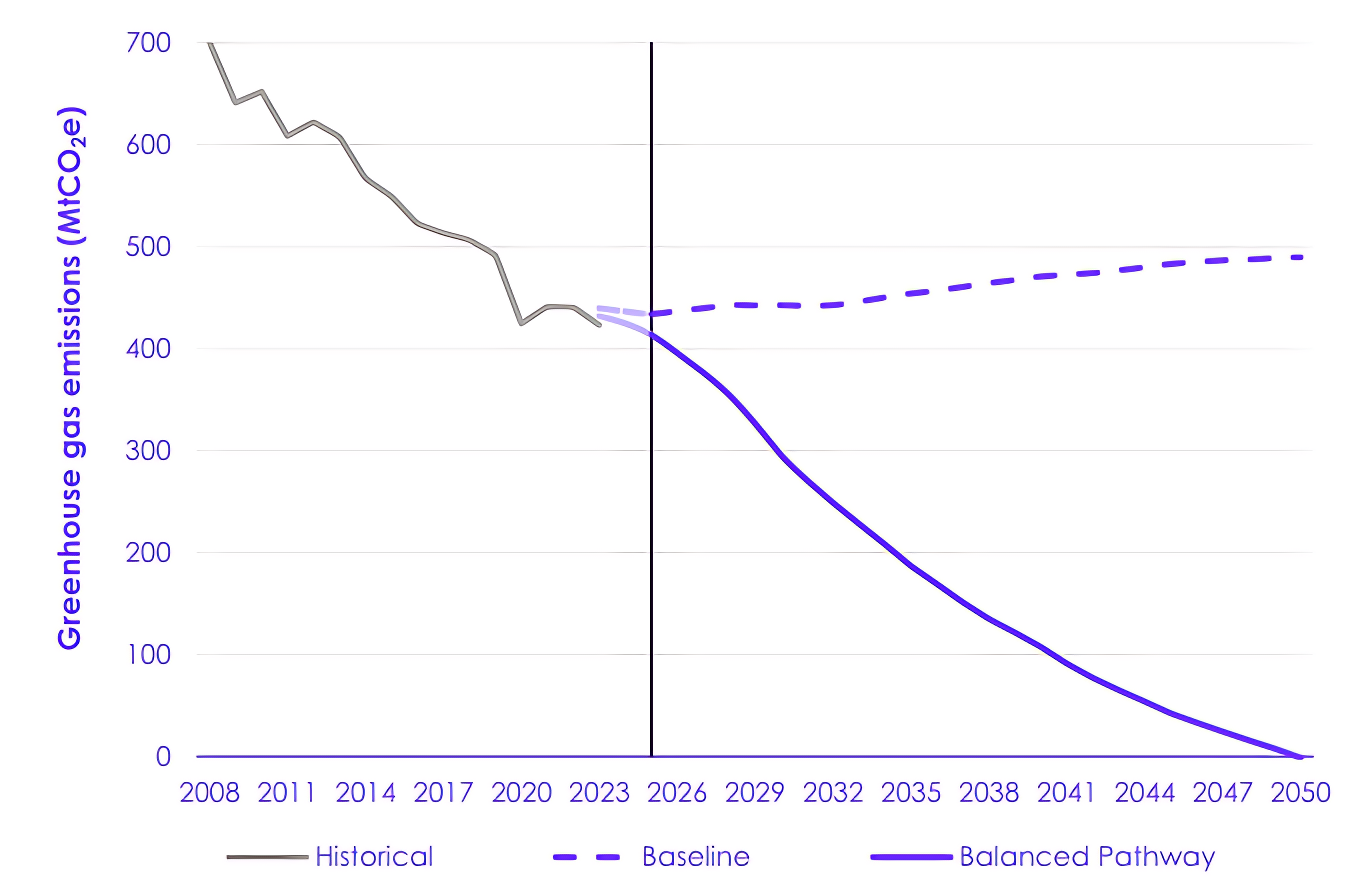
Comparison of emissions in the baseline calculation (dashed blue line) and the balanced pathway (solid blue line). Note that the seventh carbon budget (535 MtCO2e) is based on the balanced pathway and is an accumulation of the emissions across each year in the 2038-2042 period. Taken from The Seventh Carbon Budget. Larger version.
Calculating the baselines for each sector therefore meant the CCC could determine the most effective pathway to net zero—and show the difference that following these recommendations could make.
The seventh carbon budget recommendation
On the strength of this evidence presented to them, the CCC made the recommendation to cap the Seventh Carbon Budget at 535 MtCO2e for the period 2038 to 2042—a figure being discussed across policy and sector-focused media, for example:
- Carbon Herald emphasised the lower energy bills and healthcare costs that would result from meeting the CCC’s recommendation.
- ESG News discusses the impact following the recommendation would have on the UK economy and jobs.
The CCC’s advice was outlined to the Shadow Secretary of State and reflected in both Parliamentary Briefings for MPs and in the House of Commons Environmental Audit Committee’s recommendation to the Government:
Recommendation
“The Government should legislate for the Climate Change Committee’s recommended level of 535 MtCO₂e for the Seventh Carbon Budget period.”
From recommendation to policy
This week, the UK Government formally accepted the Climate Change Committee’s (CCC) recommendation, laying before Parliament a draft order to set the seventh carbon budget at 535 MtCO₂e for the period 2028 to 2042.
In doing so, the UK Government acknowledged the CCC’s evidence-based approach, recognising the budget as “the most credible and balanced option” to keep the UK on track for net zero by 2050.
The UK Government’s response also emphasises wider benefits to adopting this recommendation, including reducing our reliance on fossil fuels, supporting economic growth and improving public health and the natural environment.
The evidence suggests that meeting the seventh carbon budget will result in tangible benefits for everyday people: warmer homes, cleaner air, and lower energy and transport costs.
For the UK Data Service, this moment reinforces the importance of accessible, robust data in shaping national policy. The insights that underpin this recommendation were made possible through datasets accessed via the UK Data Service, enabling researchers to understand not just climate change but how people can be affected by it.
Meet the team


(Left) Finn Dymond-Green (They/Them) is the Director of Impact at the UK Data Service.
(Middle) Eve Little (She/Her) is one of the Impact and Engagement Managers at the UK Data Service.
(Right) Sophie Gawryla (She/Her) is one of the Impact and Engagement Managers at the UK Data Service.
Comment or question about this blog post?
Please email us!