
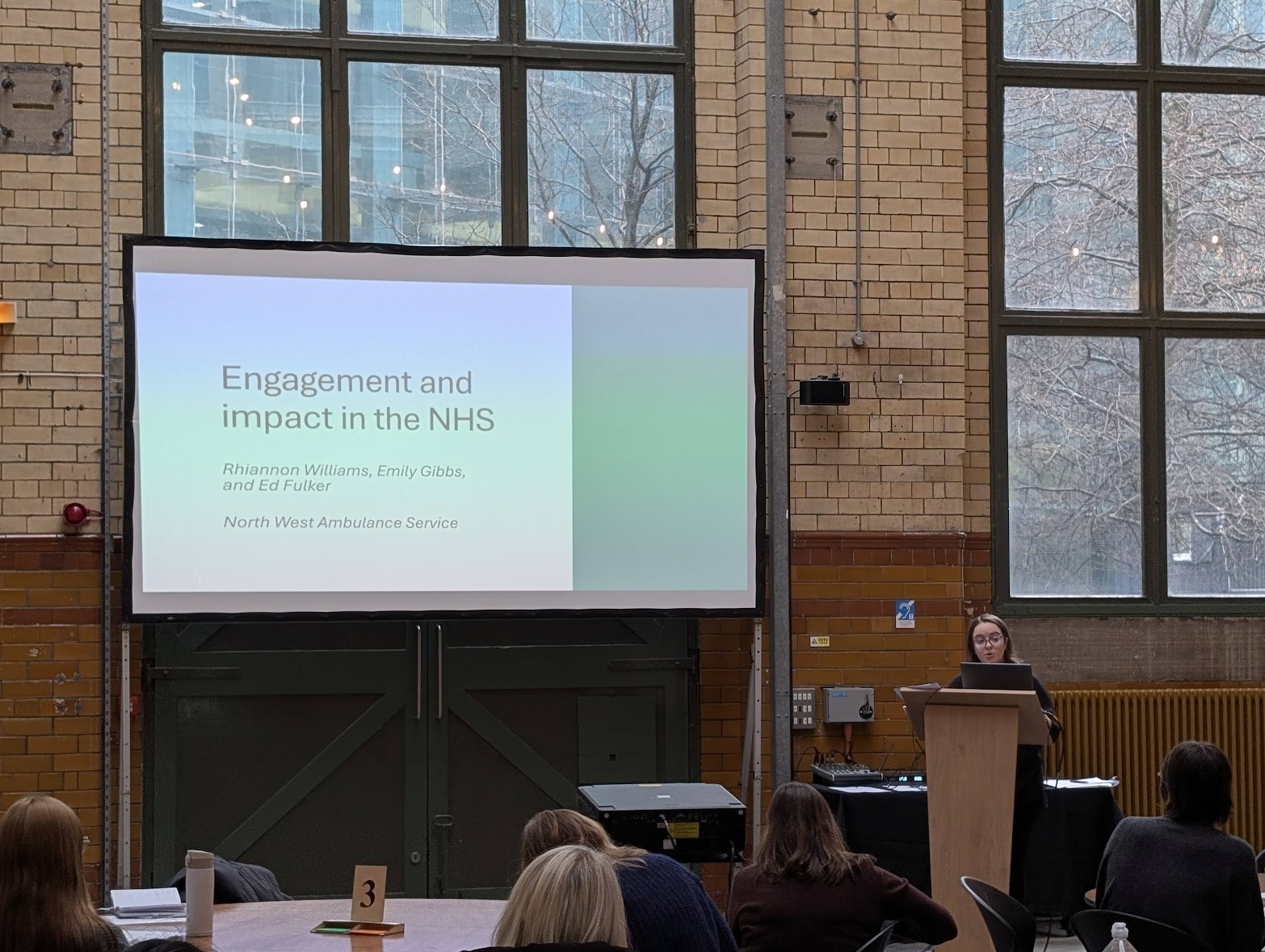
 Rhiannon Williams, one of our lightning keynote speakers at Perspectives on Engagement and Impact, discusses the different engagement avenues available to researchers wanting to generate impact in the healthcare sector.
In February, I had the opportunity to attend the UK Data Service’s Perspectives on Engagement and Impact event along with colleagues from the Evaluation team at the North West Ambulance Service.
As an embedded analysis and evaluation function in an NHS trust, engagement and impact are our bread and butter.
The purpose of a team like ours is to drive evidence-based change and collaborate with stakeholders within and outside of the trust to turn findings into action.
Our projects involve evaluating new technologies and processes to understand whether they are having their intended impacts, and making recommendations to help innovations succeed.
The key components of impact in an NHS analysis and evaluation are:
- Supporting change and finding out what works
- Turning operational complexity into something meaningful
- Drawing on the experiences of patients and clinicians to put findings into context
- Championing change when the business-as-usual is also so crucial
Knowing and reaching our audience
When an innovation is implemented in the ambulance service, its ripple effect can mean impacts for many different stakeholder groups.
These include ambulance clinicians, patients, other parts of the trusts such as dispatchers, hospitals and other healthcare professionals we refer patients to, NHS decision-makers, academics, and more.
Context is key when working in such an operational setting, so we make sure to build all of these stakeholder voices into the whole evaluation pipeline. This includes research design, data collection and analysis, and sharing our findings.
The research design stage: focusing on stakeholders
At the research design stage, we dedicate time to identifying a broad range of potential stakeholders.
We then ensure that we include these stakeholders in the design of the evaluation. This is often done via an evaluation forum, where we gather stakeholders together and collectively decide the aims and key measures of the project.
The data collection and analysis stage: drawing on different perspectives
At the data collection and analysis stage, we use mixed methods to ensure we draw on different stakeholders’ experiences and views.
We contextualise our findings throughout the evaluation process, often through clinician interviews, ambulance station visits, and observation shifts.
The results sharing stage: reaching different audiences
At the results sharing stage, we use a variety of formats and channels to reach different stakeholders. These take into account how those stakeholders work and what information they’re most interested in. Examples include presentations for senior decision makers and short bulletins for clinicians.
Connecting researchers and the NHS
Partnership working between academic research and the NHS is a powerful tool for improving patient care and healthcare knowledge, but it can be difficult to get started. Fortunately, there are several routes available to us.
Knowledge exchange activities such as student placements allow connections to be built between the two sectors and creates avenues for expertise to be built and transferred.
Another way to work across sectors is using one another’s outputs. While academics and healthcare professionals both publish to journals, valuable NHS outputs are also likely to be found in research repositories like Amber.
Drawing on resources from these spaces allows academics to access practice-based information, find out where innovation is happening in the NHS, and strengthen research with evidence drawn from real-world contexts.
The most powerful way of connecting academic colleagues with innovation in the NHS is co-designing research.
Research projects and pilots of interventions led by multidisciplinary teams from universities, research groups, and NHS trusts mean that new ideas being explored in academia can be applied and tested in practice.
This approach is the most complex to get off the ground but can have the most meaningful impact.
Key to any kind of partnership working is understanding each other’s working styles. Colleagues from academia and the NHS are likely to be working with different priorities, focuses, timescales, and types of outputs, so spending some time understanding and bridging those differences helps support successful projects.
From a data perspective, building in time for information governance processes is particularly essential, especially if your partnership working involves sensitive variables or data sharing.
Taking part in Perspectives on Engagement and Impact
The Perspectives on Engagement and Impact event was a fantastic opportunity for our team to share our experiences of NHS partnership working and learn from other sectors.
It was exciting to meet so many Early Career Researchers interested in working with healthcare data, and particularly with underused ambulance sector data.
Events like these are extremely valuable for building partnerships between academia, the NHS, and other sectors, opening doors to future knowledge exchange and collaboration.
Meet the author
Rhiannon is an Evaluation Analyst at the North West Ambulance Service, where she uses mixed methods analysis to evaluate real-world interventions in the ambulance sector.
Before joining the NHS, she carried out a PhD and post-doc at the University of Sheffield. Her PhD was part of the Data Analytics & Society Centre for Doctoral Training and used quantitative analysis to explore the impacts of Universal Credit in the UK.
Comment or question about this blog post?
Please email us!