

Mental health struggles and money worries rarely happen in isolation, and the relationship between them can be complex. Dr Emma Bridger, from the University of Leicester, uses innovative network analysis and Understanding Society data to map these connections, revealing links between everyday hardships and specific psychological symptoms.
System approaches to public mental health
Financial disadvantage is a well-known risk factor for poorer psychological health and wellbeing. Indeed, we have recently shown that people in the UK understand this very well, especially in the case of depression.
Unfortunately, financial stressors do not arise or operate in isolation.
Risk factors for poor mental health of all kinds and dimensions, from daily life environments, stressful life experiences through to neighbourhood disorder, are more likely to be encountered for people experiencing financial disadvantage. If you experience one, you are more likely to experience others as well. These risks cluster together and can amplify one another to further damage health.
Systems-based perspectives are key to understanding the complexity of these many dimensional risks, because they help understand the joint and synergistic impact of these multiple risks.
What do we mean by a systems-based approach?
Building on ideas from the fields of Complexity and System sciences, a system-based approach is one that emphasises understanding of a phenomenon both at the level of individual components and the interactions between those components.
What is “unique” here?
Systems-based thinking also underpins the network approach to mental ill-health.
According to this perspective, psychological symptoms do not necessarily represent an underlying disorder, in the way that measles symptoms indicate the presence of an underlying measles pathogen. Rather, the specific symptoms (e.g., low mood) are themselves causally relevant and can influence one another and make other symptoms more likely to happen.
For instance, an individual may develop depressed mood from chronic stress, which leads to insomnia, then fatigue, then concentration difficulties. Over time, as these symptoms make others more likely, an individual may develop a profile that meets the criteria for a diagnosis of major depression.
Network analysis is a methodological framework that aligns with systems-based approaches because it permits a focus on specific symptoms, such as low self-worth or trouble sleeping, and their inter-relations.
The approach can also be expanded to focus on and incorporate specific elements of the external socioeconomic environment and the risks within it, such as pollution levels or difficulty paying the rent.
 Regardless, network models begin with a systems-based view and see each component of the system as interacting with and relating to all other components of the system.
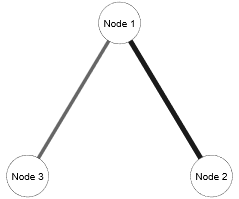
In network language, the components of the system are referred to as “nodes” and are differentiated from the associations or “edges” between each node (see Figure). Network models determine the association between each pair of nodes after accounting for everything else and all other associations in the model.
Figure 1. Simple simulated network showing three nodes and two edges. The edge between node 1 and 2 is stronger than between node 1 and 3. There is no edge between node 2 and node 3 indicating no unique associations.
This is important because any edge that is detected reveals unique co-variation between two nodes, that cannot be accounted for or explained away anywhere else in the system. This reveals unique associations between psychological symptoms and specific elements of the environment. Network modellers call these edges conditional or “unique” associations.
Understanding Society (UKHLS)
The UK Household Longitudinal Study (UKHLS) is a singular resource for examining these systems because it includes rich data on psychological health as well as on a great number of variables of relevance to socioeconomic disadvantage.
Of particular value are those waves that include measures of material deprivation at both the household level (e.g., ability to keep house adequately heated) as well as perceptions of the wider neighbourhood (e.g., vandalism). They also include area-level Indices of Multiple Deprivation (IMD) as objective multidimensional metrics of poverty.
With these data we sought to detect the unique associations with psychological symptoms within a system that includes aspects of disadvantage that operate at the household (such as household income) and the neighbourhood level (such as pollution).
We selected our nodes based on the existing literature and pre-registered all of our analyses. Following our pre-registration, we estimated a network model for 15,851 UK adults with available data.
The final network revealed that the psychological symptom connected to the most aspects of disadvantage was having mental or physical health problems that interfered with social activities. Being unable to replace large electrical items such as a refrigerator or oven was the disadvantage node associated with the most psychological symptoms. The household-level nodes tended to have stronger associations with symptoms than the neighbourhood-level disadvantage nodes.
Implications and future work
These novel analyses revealed the unique associations between specific aspects of socioeconomic disadvantage and aspects of psychological distress. They confirm that household-level financial struggles, particularly those relating to basic needs are most strongly related to specific aspects of distress.
Yet at the same time, there remained unique edges with perceptions that vandalism and attacks on people are likely in the neighbourhood. Even after adjusting for the kinds of household financial stressors that loom large, there are complex interrelationships among symptoms, between symptoms and risk factors, and among risk factors.
So yes – the systems-based approach holds up in practice. This confirms the relevance of a systems-based approach for understanding public mental health because there are unique associations between symptoms and risk factors even after accounting for other elements of the system.
These network analyses share a limitation with traditional cross-sectional analyses, in the sense that they cannot be used to make causal claims about the unique associations between elements of distress and disadvantage. It may also be the case that associations that are robust for the sample as a whole, do not necessarily operate in the same way for individuals within the sample, despite this being an intuitive implicit interpretation.
One fruitful approach to overcoming this problem is to employ models that disaggregate inter- (between-person) and intra-individual (within-person) conditional associations from one another using longitudinal panel data. This distinguishes conditional associations that vary between-people from within-person changes over time that are more appropriate for implicit causal inferences.
In current work, together with Dr Omid Ebrahimi (University of Oxford) and Dr Ludvig Bjørndal (University of Oslo), we are applying dynamic network tools that identify associations over time within systems in this way to the rich longitudinal data of the UKHLS. With this we can much better understand the reciprocal influences of mental health symptoms and experiences of financial strain over time.
About the author
Dr Emma Bridger is a Lecturer in Psychology within the School of Psychology and Vision Sciences at the University of Leicester.
Her research focuses on the social and socioeconomic determinants of health, well-being and behaviour, employing multivariate analyses to unpack how these relate to one another across the life-course, as well as experimental and survey designs to understand how more distal social determinants are conceptualised and understood.
Comment or question about this blog post?
Please email us!