

John Kenny, from the Tyndall Centre, introduces a new UK Data Service case study. The case study explores his climate change public opinion research and how his framework is shaping the design of European public opinion surveys.
In the article “A framework for classifying climate change questions used in public opinion surveys”, published Open Access in a recent issue of the journal Environment Politics, my co-authors and I aim to make interpreting survey research on climate change more accessible.
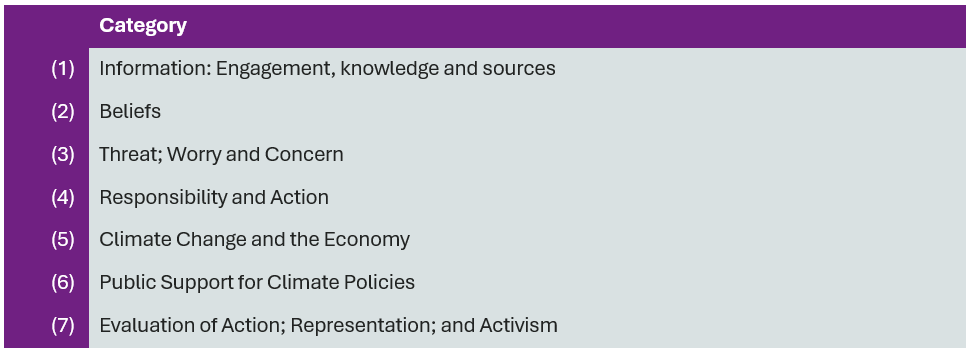
Our research for this was based on an inductive review of climate change questions asked in over 315 surveys worldwide. The analyses led us to the formulation of a 7-category framework whereby each category encapsulates a different facet of climate change public opinion. The article is also accompanied by a comprehensive, detailing all of these questions and the surveys they came from. In this blog post, I discuss the motivations behind the study and the resource that it provides.
Why clarity matters in climate change public opinion research
When I came up with the idea for this study in 2021, the social sciences were experiencing a growth in scholars interested in researching climate change. This trend was very noticeable in my own field of political science. As recently as 2014, ‘the slow response from political science as a discipline’ to climate change had been lamented at that year’s prestigious James Madison lecture.
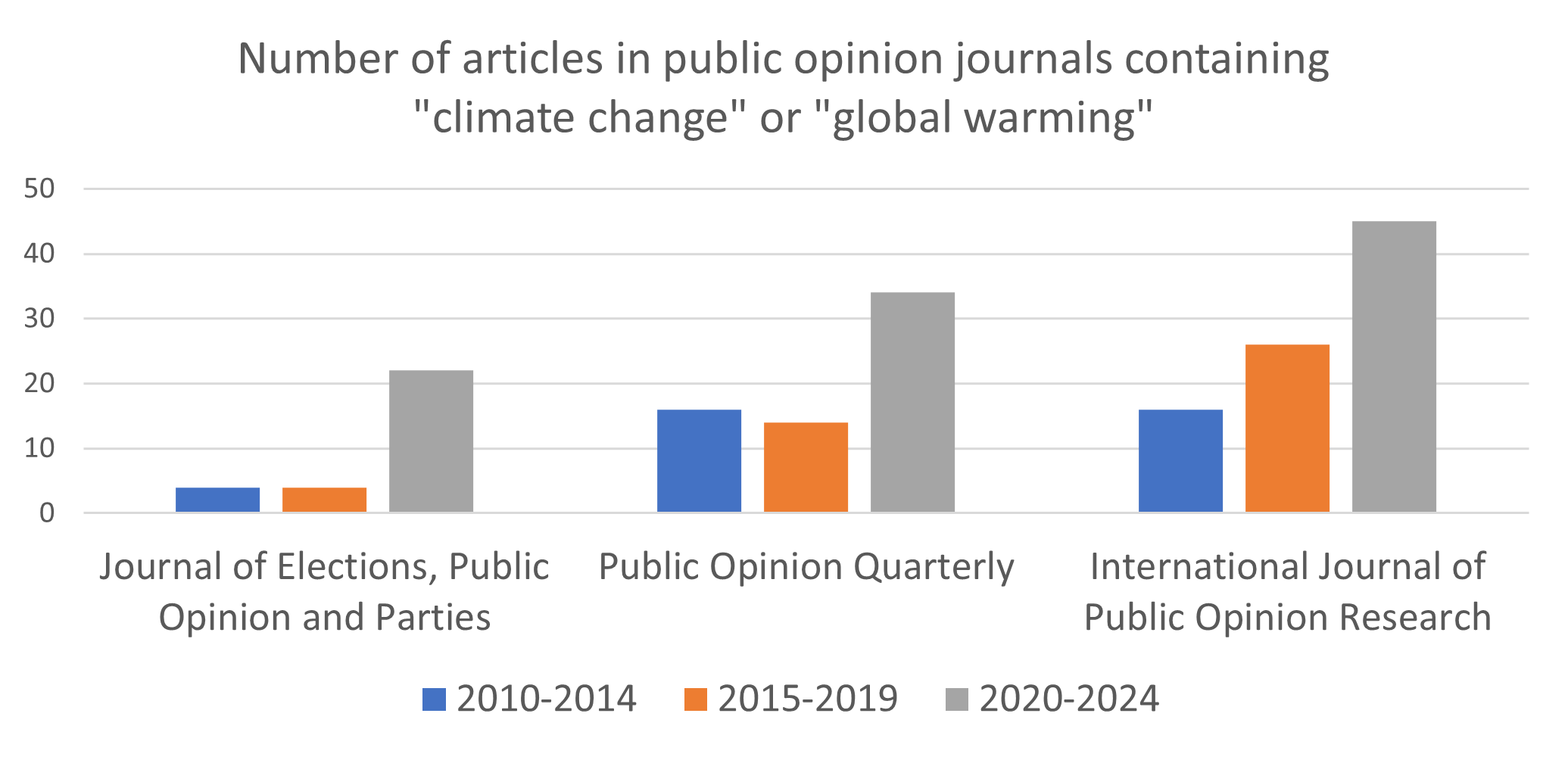
And yet in the aftermath of the high saliency of climate change in public discourse in 2018/2019, the expansion of climate politics research was clear. In the area of public opinion research, as the figure below displays, the major public opinion academic journals published more articles between 2020 and 2024 that contained the words “climate change” or “global warming” than they had in the 10 preceding years combined.
Figure 1: Number of articles in public opinion journals containing “climate change” or “global warming” from 2010 to 2024.
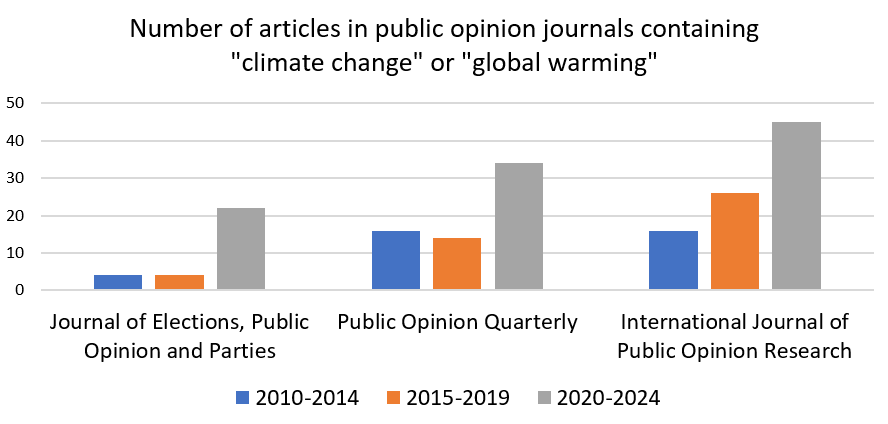
Source: Keyword searches of articles containing the words “Climate change” or “Global warming” anywhere within their article carried out on 30 November 2025 on the journal websites of Public Opinion Quarterly, International Journal of Public Opinion Research and Journal of Elections, Public Opinion and Parties. Larger version / Accessible version.
Spotting the research gap: why we needed a new resource
In spite of the growing interest in the field, I was struck by the lack of an up-to-date resource – from both a theoretical and an empirical perspective – that covered the breadth of climate change questions that could be drawn upon. Excellent articles on the topic did exist from 2007 and 2008, but the field had significantly evolved since then. Plus, these articles focused exclusively on the United States.
Climate change public opinion is an umbrella term that brings together many different foci, and so it is vital for researchers to know when they are designing questionnaires and studies what exactly they are eliciting. This is important for advances in academic scholarship, as well as for helping policymakers to receive the correct takeaways from the work. Moreover, there are different challenges and opportunities from climate change facing individuals in different parts of the world, and so survey questions need to take into account such contextual factors.
And yet a resource to help scholars in this endeavour – especially those who were entering the field for the first time – was lacking.
This gap inspired our carrying out of research that could provide such a resource.
From questions to categories: piecing together the puzzle
The first step was to locate a wide range of survey questionnaires that had asked questions about climate change or global warming. Two data archives were absolutely pivotal – the UK Data Service and the Germany-based GESIS archive. Without them, we would simply have been unaware about the existence of many key studies and survey measures that informed the work. A number of other sources were drawn upon to increase the global reach of the corpus (including the Afrobarometer, Balkan Barometer and Latinobarometer).
The next step was to bring these questions together into coherent categories. We decided to form these inductively based on what questions displayed similarities with each other, in a process akin to putting individual pieces of a puzzle together until the overall picture is clear (see the table below for the categorisation). The article then summarised these, but also importantly related the categories to existing research in the literature on each of them.
Figure 2: Summary of classification framework.
Larger version / Accessible version.
A resource for researchers
In addition to the article itself, we made the entire corpus of questions examined available as an appendix. In the appendix, each question is listed underneath the categorisation framework of the article.
This not only provides transparency, so that readers can see how the pieces of the jigsaw were put together, but it also provides a resource for those looking to carry out climate change public opinion research. For example, it may be used as inspiration for individuals who wish to design and field climate change survey questions themselves, or for individuals who want to know where to find climate change questions in existing public opinion datasets to carry out analyses on them.
In summary, the article provides a snapshot of the state of public opinion at the time of its writing and guidance on how to navigate it for both consumers of climate change public opinion and those who wish to actively carry out research on the topic. By encouraging researchers to be precise in what types of climate change public opinion they are eliciting, we hope that this will also be helpful in the achievement of policy impact as such clarity could assist policymakers in being aware of the key takeaway messages and the implications for effective policy design.
Read the case study: see the impact in action
Our framework for climate change public opinion survey questions is already influencing how major European research initiatives design their studies. It has guided research into youth attitudes and the social dimensions of the green transition, leading to its use in question design for modules within cross-national surveys now being implemented across Europe.
These initiatives – coordinated by the European Social Survey European Research Infrastructure Consortium (ESS ERIC) and supported by leading infrastructures including:
- Consortium of European Social Science Data Archives (CESSDA ERIC)
- European Values Study (EVS)
- Generations and Gender Programme (GGP)
- The Survey of Health, Ageing and Retirement in Europe (SHARE ERIC)
- The Generations and Gender Programme (GGP)
- Growing Up in Digital Europe (GUIDE)
demonstrate how a clear framework can ripple across projects and shape research on a continental scale.
Want to know more about how this research is already making a difference? Explore the UK Data Service’s accompanying case study to discover more about the study and the impact it is creating.
About the author
John Kenny is Research Fellow at the School of Environmental Sciences and the Tyndall Centre for Climate Change Research at the University of East Anglia and an affiliate of the Centre for Climate Change and Social Transformations (CAST).
He is also the author of a UK Data Service case study on his framework for classifying climate change questions used in public opinion surveys.
Other stories you’ll find interesting
Comment or question about this blog post?
Please email us!