


Alex Freeman and Tim Fellows introduce a new integration between the open research platform Octopus.ac and the UK Data Service. Using “Pearls” to wrap existing UK Data Service datasets without duplication, the integration lets researchers cite, build on and track reuse of data more easily than ever before.
The alternative publishing platform Octopus.ac has launched a new integration with the UK Data Service to help make the datasets more easily discoverable and reusable by researchers.
Octopus is a free open research publishing platform that aims to solve various issues in the research culture by incentivising researchers to share the full detail of their project.
Instead of publishing a single unit, as with a traditional paper, Octopus has a modular publishing structure that can be used to more accurately map a project. Each publication is linked to its predecessor to create a “chain”, and can be reviewed separately.
This structure enables researchers to use Octopus to share datasets as individual Results publications, linked back to their Methods, and to the Rationale behind collecting them.
By creating separate publications for each dataset and the context surrounding them, Octopus can be used to present data in a structured, citable manner, and with clear credit given to the researchers who worked on each part of the project.
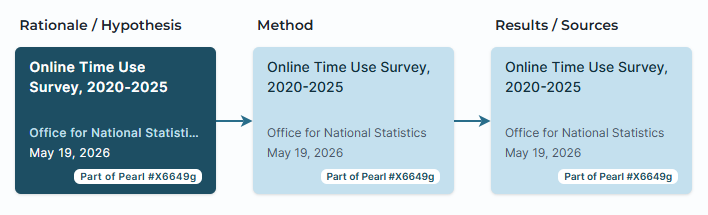
Figure 1 – Example publication chain on Octopus, showing a dataset wrapped as a Pearl
What are Pearls?
Normally, all publications on Octopus have to be linked to an existing publication and no part of a publication chain can be missing.
“Pearls” are special wrappers that allow existing digital assets – such as datasets, codebases, manuscripts – to be pulled into the Octopus platform without duplicating them, or needing complete Octopus publication chains.
It means that the data, and its associated method and metadata, can easily be found and built on by researchers.
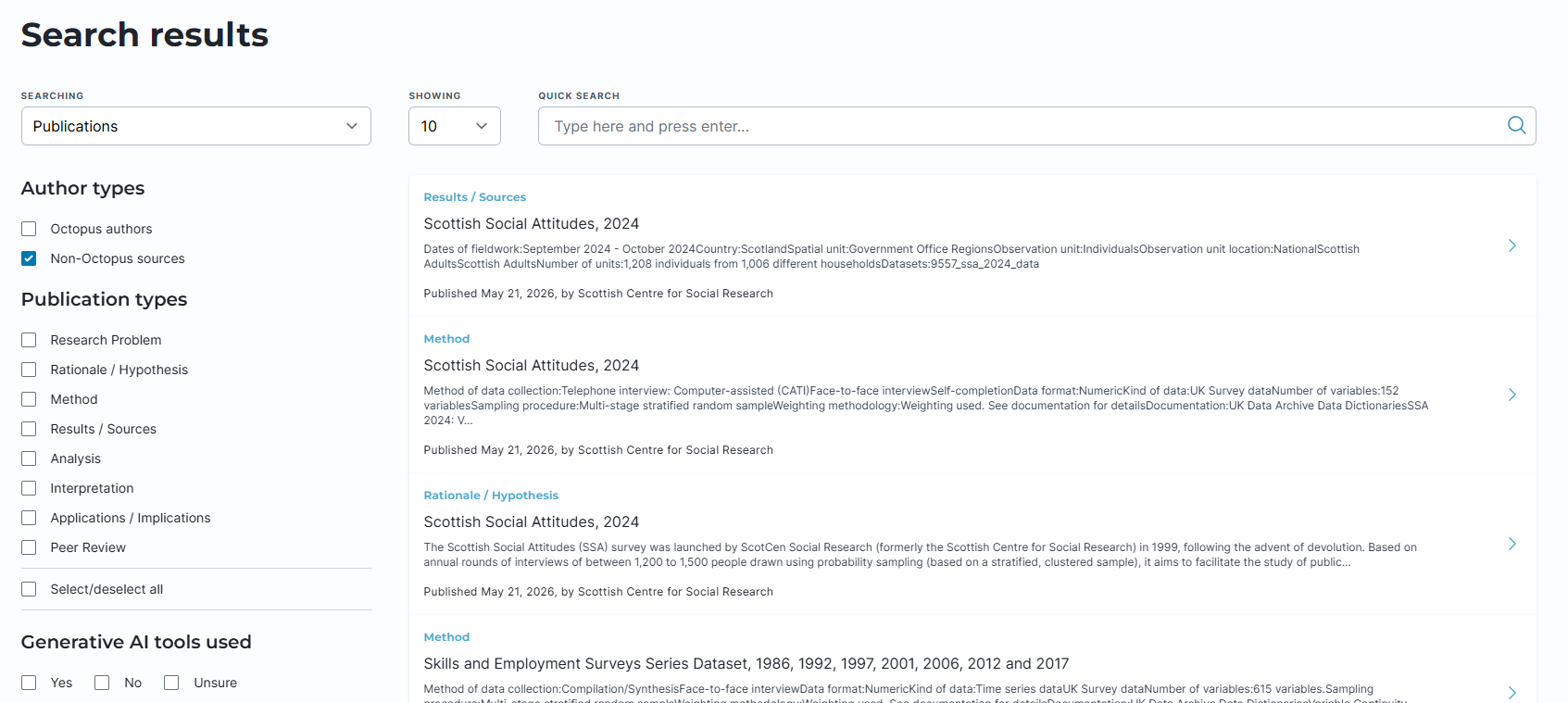
Discovering and building upon Pearls is easy, and can be done simply by using the “Non-Octopus sources” search function.
Each Pearl contains links back to the original documentation and datasets on the UK Data Service site for further reading and can be linked like any other publication.
Figure 2 – Searching for non-Octopus sources on the Octopus platform
Easier to find, to publish, and to track
Because of its modular structure, Octopus allows researchers to publish an analysis, or meta-analysis, linked from one or many datasets quickly and for free.
There is no need to write long introductory material, or describe the dataset and the method by which it was collected as that information is all already in the Pearl. Authors can launch directly in with their own analytical method and findings.
Publication on Octopus is immediate, and others can then freely link post-publication peer reviews. Authors can re-version publications if they like.
Figure 3 – Linking to a Pearl when adding a new publication on Octopus
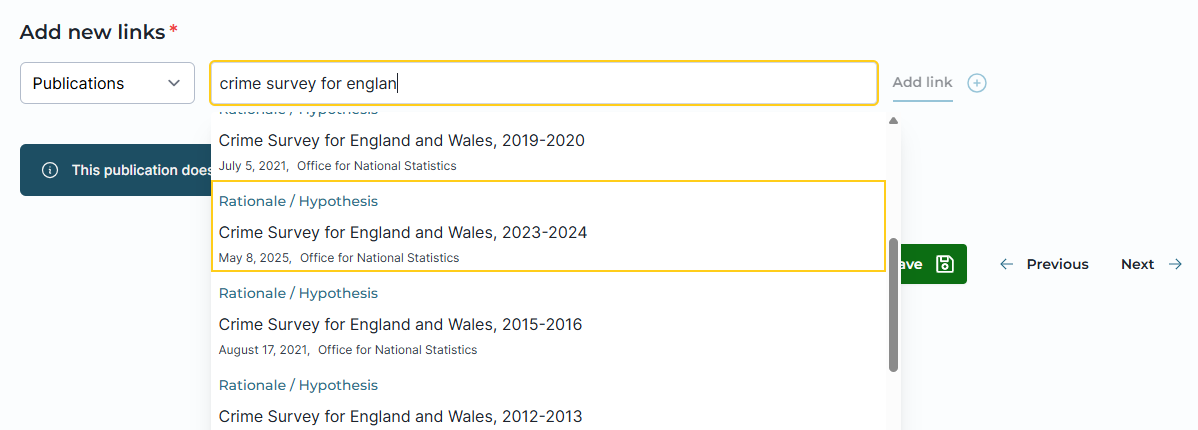
Because of the links in publication chains, funders and institutions can easily track reuse of their datasets through Octopus.
This represents the first of a planned series of integrations to pull digital research objects such as datasets or digitised manuscripts onto the platform to help researchers find them, and to make it easier to publish and track new work that builds upon them.
Ultimately, our hope is that it will create a more transparent and collaborative research landscape as authors can publish more easily, without barriers and review each others’ work.
If you have any questions or have suggestions for other research repositories that Octopus could link to, please get in touch via alex@octopus.ac.
About the authors
Alex Freeman is the Director of Octopus.
After a career in documentary-making, she returned to academia and was surprised to see how much publishing controlled the academic incentive system and decided to create a new platform that could reset the incentives towards best research practice instead. Octopus.ac is the result, funded by Research England.
Tim Fellows is a product manager specialising in research support systems and scholarly communications.
Prior to his work on the Octopus platform, Tim has worked on clinical trials training, human tissue banking, ethics review, equipment data and journal usage statistics platforms. In his work on the Octopus platform, Tim hopes to support a change in the researcher incentives structure to provide greater recognition and reward for the sharing of methods, data and other outputs that do not currently see sufficient focus.
Comment or question about this blog post?
Please email us!