
 |
 |
 |
 |
| Dr Elizabeth Green | Dr Hilary Lowe | Jo Webb | Leigh Tate |
The Optimising Data Professional Success (Odyssey) team explore how targeted training, clearer career pathways, and better recognition can support data professionals to thrive and strengthen data services across the UK.
The Odyssey Initiative, (otherwise known as Optimising Data Professional Success: Identifying Skills, Career Trajectories, and Training Requirements for Enhanced Data Service Delivery), addressed the most important area for data services – our staff.
A collaborative project led by Elizabeth Green (University of the West of England) and involving the UK Data Service, DataLoch, Research Data Scotland, OpenSafely, and the UK Longitudinal Linkage Collaboration (UK LLC), investigated how the sector could equip data professionals through targeted training and support them with purposeful career mapping and strategic development support.
We weren’t sure how staff would interact with the project and ideas, but we discovered that there is a real need to support staff in their development and career planning.
Defining Odyssey’s Mission
We set out on a journey to answer three pivotal questions:
- Which skills are most vital? – Understanding the technical, interpersonal, ethical, and managerial competencies that data professionals need for success. Are these skills adequately reflected in job descriptions, recruitment processes, and training?
- How do careers progress? – Mapping typical career paths to identify transitions, bottlenecks, and areas for growth.
- What training works best? – Evaluating existing learning offerings, spotting gaps in support, and setting out a pathway for development.
Through stakeholder interviews, skills inventories, and training assessments, Odyssey painted a comprehensive portrait of the data profession.
Outcomes
1. Skills-career framework
The development of a skills-career framework that aligns proficiencies – such as data curation, metadata application, and secure data handling, along with wider skills such as stakeholder communication and project management – with job levels, from junior analysts through to senior data leads.
The intention is that the framework makes it easier for people to benchmark their current skills, design a personal development plan, and identify training available.
By clarifying career ladders, organisations can support staff progression, recognising both technical mastery and growth in leadership skills.
The framework is free to use and is available on the Odyssey project website.
2. Training landscape & gaps
Odyssey identified general training needs common to many roles in data services:
- Technical training: focusing on data architecture, metadata standards, and secure data management tools
- Analytical development: including statistical methods, data visualisation, and reproducible research
- Professional skills: such as project management, ethical data stewardship, and client engagement
By mapping existing UK Data Service, university, and third-party offerings against required competencies, Odyssey highlighted areas of duplication, gaps, and a need for more structured, role-mapped learning pathways. The information is available through the Odyssey Training Resources website to enable people to build a bespoke training programme either for themselves, or for their teams.
The UK Data Service offers an ever expanding programme of training from introductory courses about data through to sessions on new and emerging tools. The programme is added to all the time, so sign up for our newsletter or follow us on linkedin.
3. Recruitment and development packs
Advice for managers covering onboarding and offboarding, managing performance, advice on employment issues, and example interview questions for various roles are also available through the Odyssey Training Resources website.
Led by the team’s Human Resources expert, Dr Hilary Lowe, the advice has been developed taking into account the likely backgrounds and needs of data centre staff.
Feedback from the field
Jo and Lizzie from the Odyssey team, along with colleagues Hollydawn Murray and Ruth Norris from other data services, delivered a workshop at the UK Trusted Research Environment (TRE) Community conference in September 2025.
This workshop explored current initiatives and future priorities for supporting career development among professionals working in data services, including those involved in secure data environments (SDEs), TREs, and data governance functions.
The workshop brought together 15 participants from universities, government, and the charitable sector. Participants reported a range of existing initiatives in their workplaces, including training, mentorship, and emerging career frameworks, but highlighted ongoing barriers such as limited time, resources, and institutional recognition.
Participants fed back that for many, it was the first time they had had the space to think about their careers, discuss their situations with peers and look at what might be needed to help them progress, not just at a personal level, but what was missing at an institutional and sector level.
The workshop revealed clear enthusiasm for more structured and supported career development across data services, although participants emphasised that progress is constrained by limited institutional resources and recognition. Targeted investment in both technical capabilities, such as AI, automation, and statistical disclosure control, and professional skills in project management and engagement would help strengthen capacity across the sector. Establishing a shared career framework could enhance mobility, consistency, and equity between institutions, provided it is underpinned by effective cross-organisational collaboration.
Example outputs from the workshop held at the UK TRE Community conference

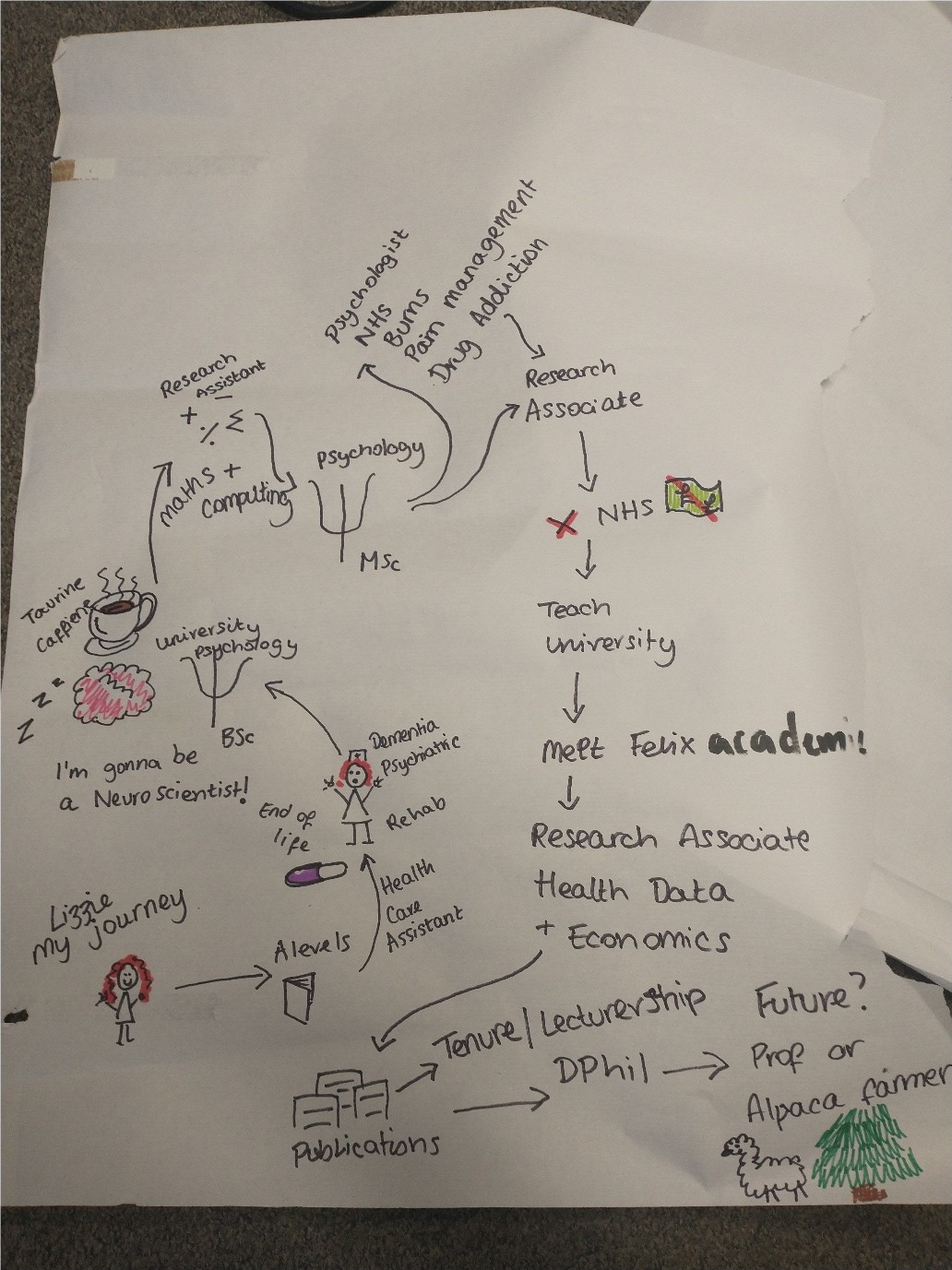
Left: From Astrophysics then Motherhood to data services, Larger version
Right: A typical route into data services – a winding path, Larger version
The team presented a poster at the UNECE Expert Meeting on Statistical Data Confidentiality in October 2025: When Frameworks Miss the Mark: Understanding the Misalignment Between Data Service Competencies and Workforce Realities. The team enjoyed talking to delegates about their career paths and plans and many commented they had not had the chance to discuss their working journeys in a professional setting before. The appetite to take part in future opportunities is high.
A particular focus of discussion was work by Lizzie Green and Hilary Lowe on the gender bias evident in recruitment advertising for data professionals. This followed up from a presentation at IASSIST 2025.
The Odyssey Team presentation at UNECE 2025
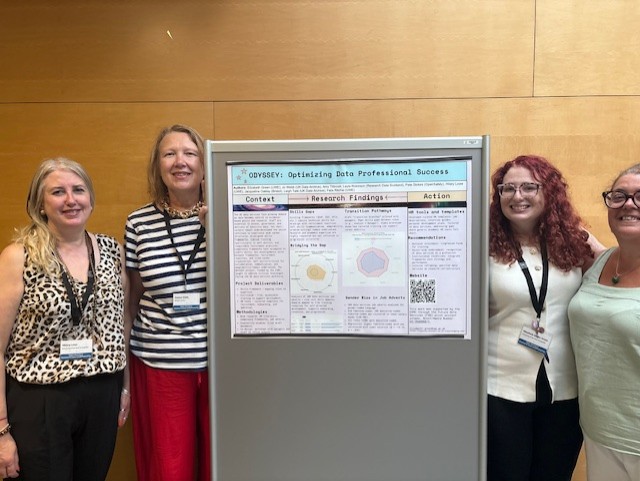
From Left to right: Hilary Lowe, Jo Webb, Lizzie Green, Leigh Tate, Larger version
Conclusion
Training data professionals matters. It ensures the sector can sustainably manage, curate, and deliver high-quality data services. With a clearer understanding of skill requirements, career progression, and training effectiveness, institutions can:
- Boost service quality with better equipped staff to support researchers, policymakers, and public partners.
- Identify, retain and develop talent: structured career development increases job satisfaction and reduces attrition.
- Optimise investment: coordinated and relevant training avoids duplication, fills critical gaps, and empowers data leads efficiently.
In short, Odyssey is a start to making skills visible, careers navigable, and training strategic.
There is a gap in recognition of the particular career paths for data professionals, their needs, and the space and support for them to flourish in the sector. Odyssey contributed to recognising the challenges of a career in data services and started a conversation on how to invest and support all of us working in data services.
About the authors
Dr Elizabeth Selina Green is a Senior Lecturer in Economics at the University of the West of England.
She began her career in healthcare and psychology before moving into economics and data governance, bringing lived experience from frontline public services into the data world. Her work explores how trust, behaviour and ethics shape the use of sensitive data, and she is committed to promoting inclusive pathways into data careers for people from non-traditional and interdisciplinary backgrounds.
Hilary Lowe obtained her PhD from Cardiff University in 2012. She joined the University of the West of England in 2011 as a Senior Lecturer in HRM and is currently the Bristol Business School Director of Partnerships and International.
In this role, Hilary draws on extensive experience in international education to inform her pedagogical and strategic interests in Transnational Education (TNE). Her research focuses on labour market outcomes for young people, labour market skill gaps, wellbeing at work, and quality processes in TNE.
Jo Webb MBA CMgr MCMI is Head of Department at the UK Data Archive, based at the University of Essex.
She has extensive experience in strategic leadership, governance, and operational delivery within research and data-driven environments. Jo is passionate about developing people and is Co-Investigator on the ESRC funded Odyssey project looking at data professional career pathways.
Leigh Tate is the Data Access Services Manager at the UK Data Archive.
Leigh is responsible for ensuring that researchers are able to access high quality data smoothly and efficiently. She is evangelical about the need for staff in data services to be supported, developed, and able to see a clear career path
Other stories you’ll find interesting
Comment or question about this blog post?
Please email us!