
 |
 |
||
| Elaine Robinson | Juliet Stone |
Elaine Robinson and Juliet Stone, from the Centre for Research in Social Policy, share insights from their quantitative analysis underpinning Marie Curie’s Dying in poverty campaign.
Here at the Centre for Research in Social Policy (CRSP), we specialise in the research and analysis of living standards. The core of our work is the Minimum Income Standard (MIS), which, among other things, forms the basis of real living wage calculations and the Scottish Government’s fuel poverty metric.
Since 2019, we have been working collaboratively with end-of-life charity Marie Curie to provide the quantitative analysis underpinning their Dying in poverty campaign.
We explored the risk of living in poverty for working aged people and pensioners and compared those in the last year of life with those who were not in the last year of life. Following our initial analysis for 2019, we have conducted subsequent updates for 2023 and 2024 data.
Innovative methods
For our analysis, we needed to be able to identify people who died, but also needed detailed information about their household income, demographics, and other characteristics.
We therefore used one of the few data sources that provides all of that information – Understanding Society, the UK Household Longitudinal Study (UKHLS).
A key strength of this survey is that data is sourced from a large number of households (approximately 40,000) across the UK. The same households are tracked over multiple waves of the survey across the years. Whether a survey respondent was in the last year of life is derived retrospectively if they are recorded as deceased in the subsequent survey wave.
One of the key problems when conducting analyses of mortality is that sample sizes are small, especially for those of working age. So, we used data from multiple years (2011 onwards) to maximise the sample size available for analysis.
A further benefit of this approach is that it smooths the impact of exceptional events, such as the Covid-19 pandemic or the subsequent cost-of-living crisis, on our findings. Conversely, one drawback of this approach is that we cannot use it to study the impact of one-off events.
Using the survey data, we were able to model the relationship between poverty and mortality, broken down by age group, sex, and geographical location. We then combined this with official estimates of poverty rates from another UK-wide survey – the Family Resources Survey – and administrative data on mortality rates.
This allowed us to scale up the estimates to population level. In our latest analysis, we estimated that more than 100,000 people are dying in poverty every year.
Insights into poverty at the end of life
In addition to producing our headline estimates of dying in poverty, we analysed a wide range of demographic variables. We found that those of working age are at greater risk of experiencing poverty at the end of life than pensioners.
To explain this in a more tangible way, we looked at the nature of material deprivation for working aged people at the end of life.
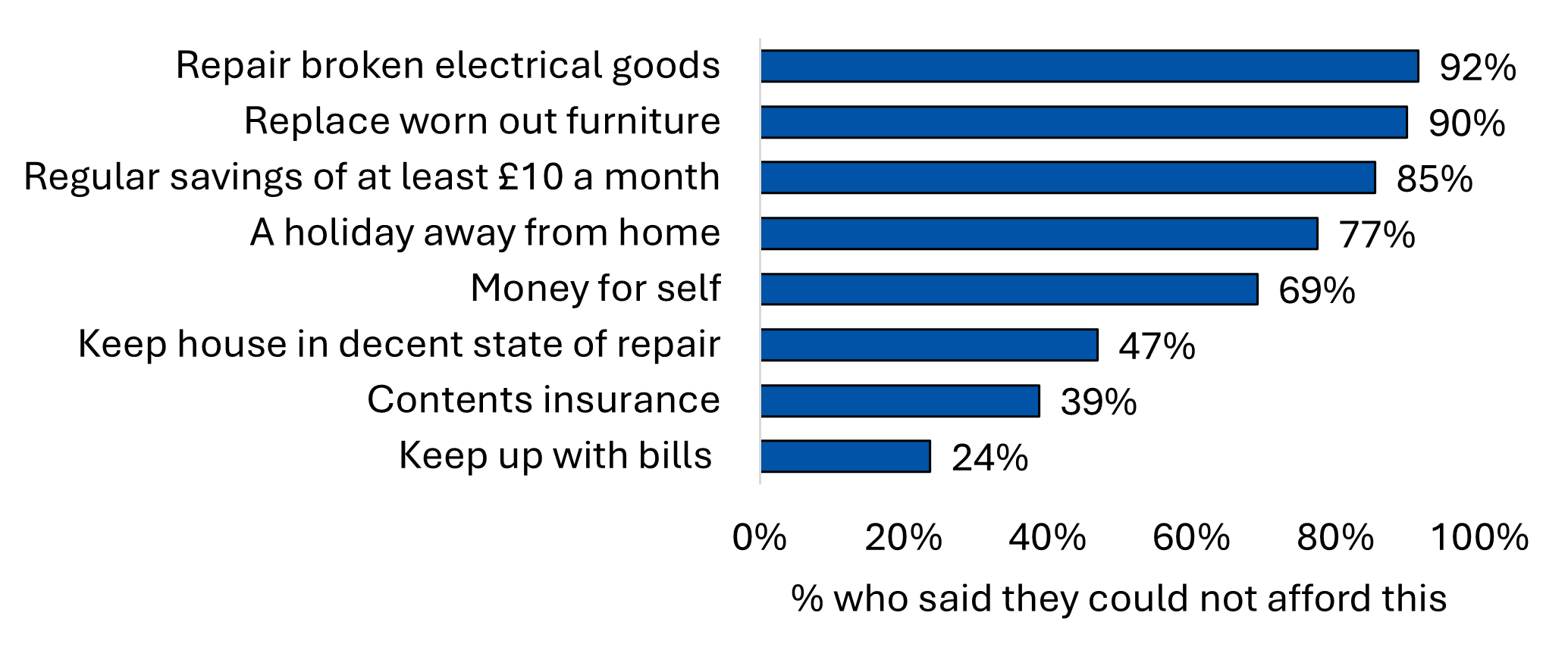
We found that deprivation most commonly manifests itself as finding it unaffordable to repair or replace broken items – such as electrical goods (92%) or furniture (90%). This paints a particularly stark picture of the precarious financial position of those at the end of life.
Figure 1: Experiencing material deprivation at the end of life, by specific working items (working age)
Larger image / Accessible version.
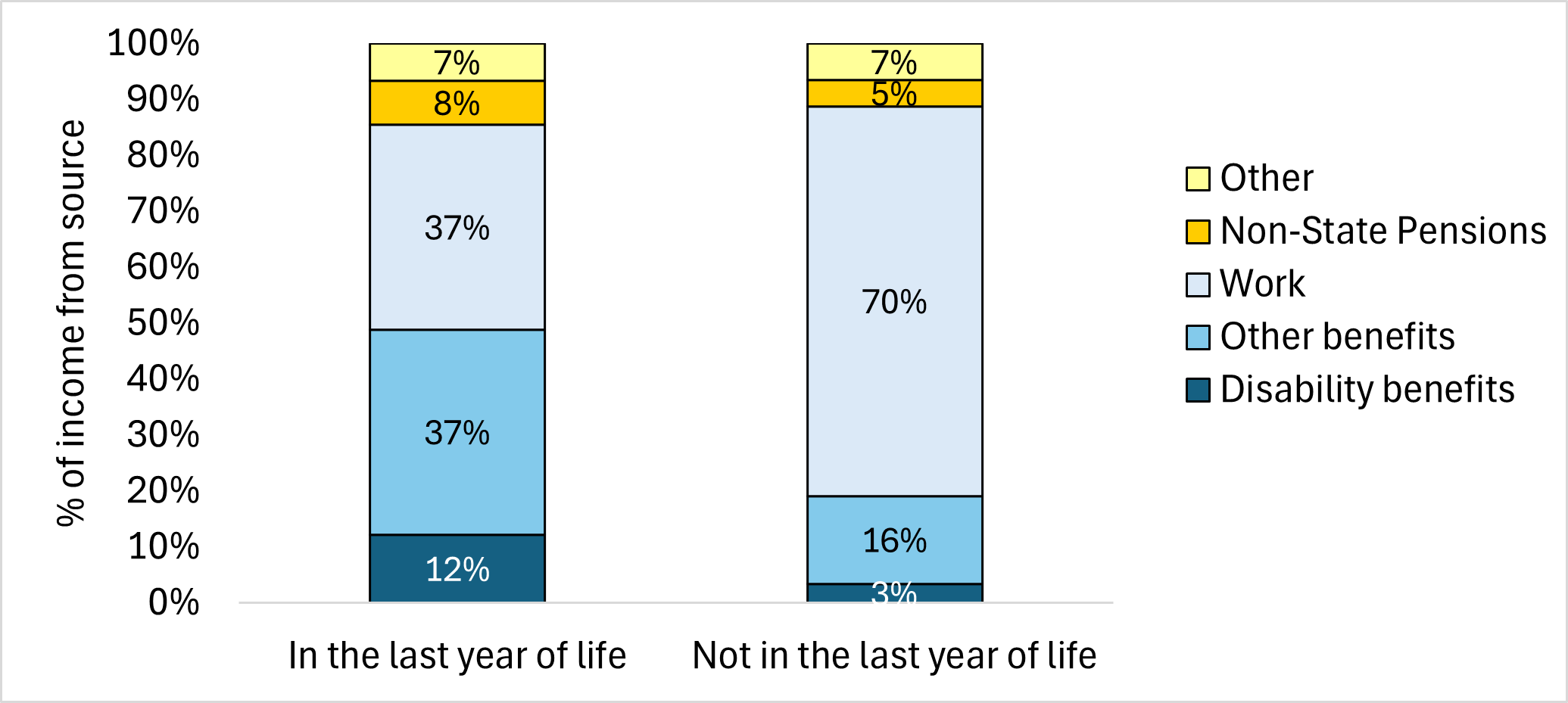
Another aspect we examined was how income sources changed for working aged people in the last year of life.
We found that almost half of their income in the last year of life was from disability or other benefits, compared to previously when the vast majority (70%) of their income was from work. This emphasises the importance of ensuring that working age benefits are adequate to live and die with dignity.
Figure 2: Income sources (working age)
Larger image / Accessible version.
Research impact
The results were used to inform Marie Curie’s campaigns and the research is gaining political traction – Dying in Poverty 2025 was the subject of an Early Day Motion in Parliament.
In terms of practical impact on the lives of the terminally ill, it has led to several Local Authorities – a total of 16 councils, including Manchester – offering council tax rebates to those with a terminal diagnosis.
Reflections on our research
The initial analysis has been repeated and CRSP have a continuing and fruitful collaboration with Marie Curie. We have since conducted analyses of fuel poverty at the end of life and the impact a social tariff might have on alleviating it.
We hope to focus on other facets of poverty in future research, as part of our ongoing relationship with the team at Marie Curie.
Meet the authors
Dr Elaine Robinson is a Research Associate at the Centre for Research in Social Policy at Loughborough University.
Her role involves developing and undertaking quantitative analysis of large data sets, in order to identify patterns and trends related to low income and fuel poverty.
Dr Juliet Stone is a Research Fellow at the Centre for Research in Social Policy at Loughborough University.
She has a background in social epidemiology, and her current work focuses on quantitative analysis of poverty and income adequacy, with a particular interest in analysing inequalities from a life course perspective.
Comment or question about this blog post?
Please email us!