
 Dr Lucas Paulo da Silva, Senior Research Associate at the University of Zurich, uses British Election Study data from the UK Data Service to explore how politically cross-pressured audiences – those who don’t fit neatly left or right – choose their news.
How do people choose political news when no news outlet really represents their views?
Using data from the British Election Study (hosted by the UK Data Service) alongside other data sources, my recent research explores this question among a large but often overlooked group: those who are politically cross-pressured. What I found suggests that media choice is more complicated, and potentially more consequential, than we often assume.
Most discussions of political media begin from a familiar observation: people tend to prefer news that agrees with them. Conservatives consume conservative media. Progressives consume progressive media. This tendency, often called “selective exposure”, has become a central idea in political communication research.
But what happens if no major news outlet fully matches your beliefs?
That question motivated my recent study, which combined an original survey experiment with large-scale panel datasets from the UK, United States and Germany.
The British component relied heavily on the British Election Study (BES), accessed through the UK Data Service. Without this resource, it would have been far more difficult to understand how people navigate real-world media environments over time.
The audiences caught between political camps
Political debate is often presented as a simple left-versus-right contest. Yet many people do not fit neatly into either side.
In my research, I focus on what are called cross-pressured audiences. These are people whose views pull them in different political directions. Some favour economic redistribution and a larger welfare state while holding culturally conservative views on issues such as immigration and gender (left-conservatives). Others hold economically right-leaning views while taking progressive positions on cultural issues (right-progressives).
Cross-pressured audiences are more common than many people realise. Recent research increasingly suggests that they make up a substantial share of electorates – between a quarter and a half – across many Western democracies, a pattern also found in large-scale cross-national data.
Their position creates an interesting challenge. Most political news outlets tend to be left-progressive, right-conservative, or somewhere in between, with few outlets representing cross-pressured audiences (see Figure 1).
Figure 1 – Illustration of media selection dilemma for cross-pressured audiences
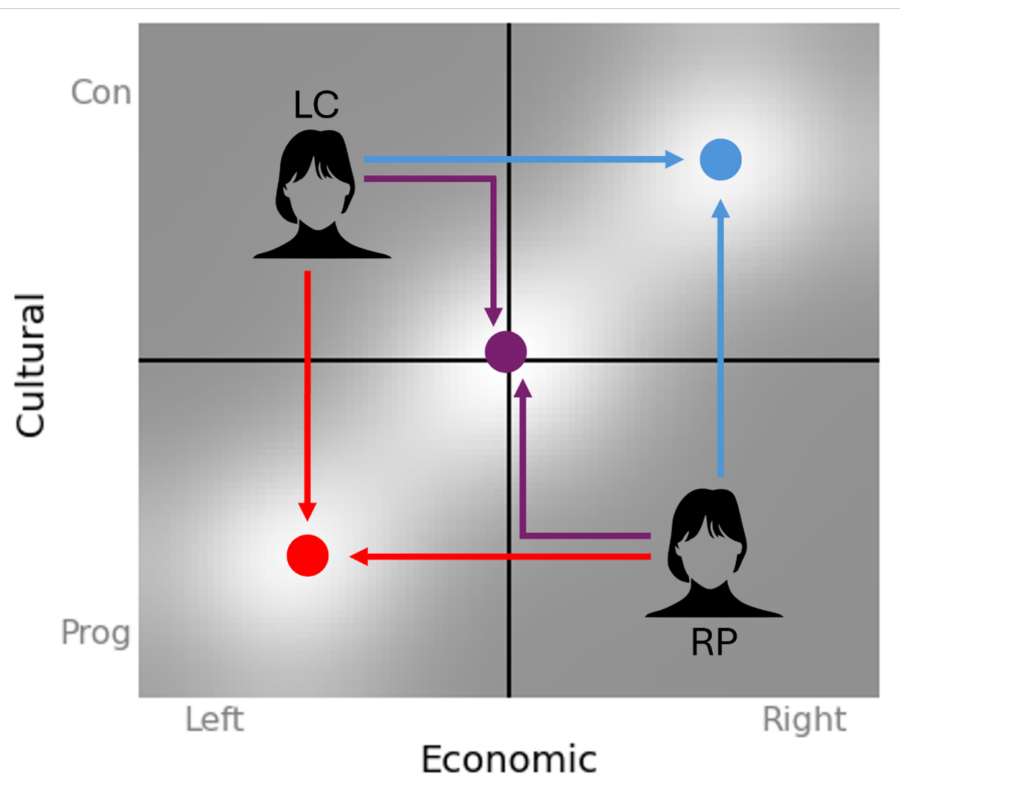
When such people open a news website, browse a newspaper, or scroll through an app, they face a dilemma: which kind of disagreement are they willing to tolerate?
That question gave my study its title: “What Kind of Bias Do I Want?”
Using BES data to study real-world media choices
One of the biggest challenges when studying media behaviour is balancing realism with causal evidence.
Survey experiments allow researchers to test how people make choices under controlled conditions. However, real media habits develop over months and years in a real-world environment, not during a single survey in a controlled environment. To complement my experiment, I therefore turned to several longitudinal panel studies, including the BES.
The BES is particularly valuable because it follows thousands of individuals across many years while collecting detailed information about their political attitudes and media use. For my study, I used data spanning multiple waves between 2014 and 2024, covering more than 53,000 individuals across 185,000 waves of the survey.
This allowed me to examine whether the patterns observed in the experiment were reflected in the behaviour of real citizens making real media choices in the United Kingdom.
More broadly, it highlights one of the strengths of large-scale social science data infrastructures.
Questions that initially emerge in experimental settings can be tested against representative population data. This creates opportunities for triangulation between diverse sources of data, increasing confidence in findings and helping researchers distinguish enduring behavioural patterns from one-off survey effects.
A consequential pattern
I expected cross-pressured audiences to be somewhat more likely to select right-conservative media outlets (e.g., The Telegraph) versus left-progressive ones (e.g., The Guardian). What surprised me was how strongly lopsided their media diets were.
Across several datasets – including the BES – cross-pressured people generally consumed media that leaned more toward the right-conservative side of the political spectrum than the left-progressive side. This was especially noticeable among left-conservatives.
In my survey experiment, more than three-quarters of left-conservatives selected the right-conservative news outlet when presented with a choice between hypothetical left-progressive and right-conservative outlets, where no established media habits existed.
The BES data revealed a similar pattern in real-world media diets. On a scale from 0 (completely left-progressive) to 100 (completely right-conservative), left-conservatives had media diets with an average score of 64, while right-progressives had 57. Both groups resembled right-conservatives much more than left-progressives, despite having similar levels of ideological disagreements with the two latter groups.
I also examined why this might be the case. My findings show that past support for right-conservative parties may push cross-pressured audiences into cultivating a more right-conservative media diet. This may then become a cycle – with media diets influencing party support and party support influencing media diets.
These findings are particularly interesting because these voters are often viewed as electorally persuadable. They possess reasons to support parties on both sides of politics and are therefore frequently seen as an important swing constituency.
Looking beyond outlet choice
The study also suggested that understanding media selection requires looking beyond which outlets people choose. Many news platforms involve a second decision. After selecting an outlet, audiences must decide which specific stories to read, watch, or click.
For cross-pressured audiences, this second step turns out to be crucial because they are often exposed to outlets with which they agree on some issues and disagree on others.
I found evidence that these individuals engage in a form of selective exposure at the content level. They appear capable of navigating ideologically mixed environments by choosing stories that align with the part of their worldview that matches the outlet they are visiting.
For example, left-conservatives were much more likely to select cultural stories when placed in a right-conservative media environment (versus a left-progressive environment).
Right-progressives displayed the opposite tendency, paying greater attention to economic stories in right-conservative environments and cultural stories in left-progressive environments.
This is visualised in Figure 2, which displays:
- the proportions of participants in my survey experiment that selected a hypothetical right-conservative outlet or left-progressive outlet
- how these groups selected content from these outlets.
Figure 2 – How cross-pressured audiences select outlets and articles
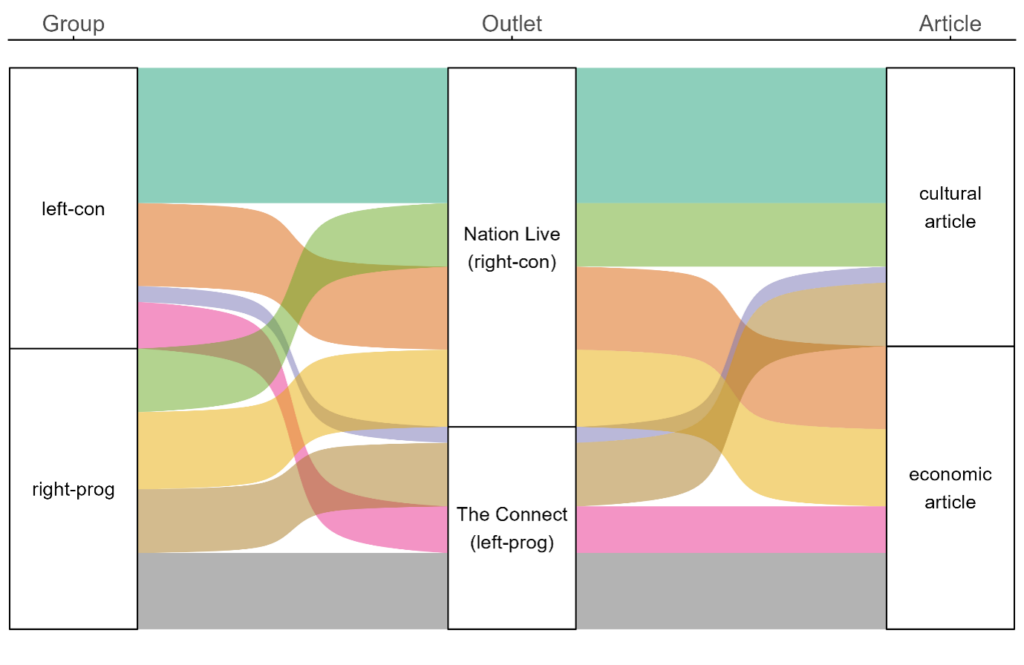
Note: “Con” denotes conservative and “prog” denotes progressive.
Why this matters
Media researchers often focus on ideological polarisation. Yet the experience of cross-pressured audiences reminds us that political identities are often more complicated than the labels we use to describe them.
For these people, media consumption involves navigating competing beliefs rather than simply reinforcing existing ones.
If cross-pressured audiences disproportionately encounter particular kinds of political content, this could affect issue priorities, opinions, perceptions of parties, and ultimately electoral choices. Since these voters may be especially persuadable, understanding their information environments is important for understanding democratic politics more broadly.
Why data access matters
This project depended heavily on access to high-quality longitudinal data.
The BES allowed me to test ideas developed in a survey experiment against a decade of real-world political behaviour. That combination of methodological approaches strengthened the research considerably. Without access to the BES through the UK Data Service, it would have been much harder to establish the real-world media diets of British audiences, which lays the foundation for the other results in my paper.
And as political identities continue to evolve, I suspect that there are many more stories waiting to be discovered in the data.
About the author
Dr. Lucas Paulo da Silva is a Senior Research Associate at the University of Zurich.
His research examines political communication, media effects, public opinion and electoral behaviour. He combines experiments, panel data, and computational methods to explore these questions.
Dr. da Silva has often used datasets via the UK Data Service, including the British Election Study and British Social Attitudes Survey, to study how media shape political attitudes and voting decisions.
Comment or question about this blog post?
Please email us!