
 Camilla Philpot Thomsen started as Associate Director for Data Operations at the UK Data Service in mid-September 2024. One year on, she now reflects on what has been a fast, fascinating and acronym filled adventure – full of learning, collaboration and ideas.
Before joining the UK Data Service, my background was in university administration and management, and for ten years I was the Department Manager of Sociology and Criminology at the University of Essex. This meant that I could apply my strategic and staff management skills to my new role – but it also meant that the learning curve for all the data terminology and acronyms was steep! A year on, I have now gained a clearer understanding of the data landscape.
Strategies and networking
Early on, I developed a User Experience Strategy for the service, which set out a framework for coordinating and structuring the user experience activities taking place across different UK Data Service teams. This led to a review of how we capture feedback – from improving the pop-up survey on the website to adding a feedback feature in the existing catalogue, so we could compare insights with those from the new Data Catalogue (launched in September 2025).
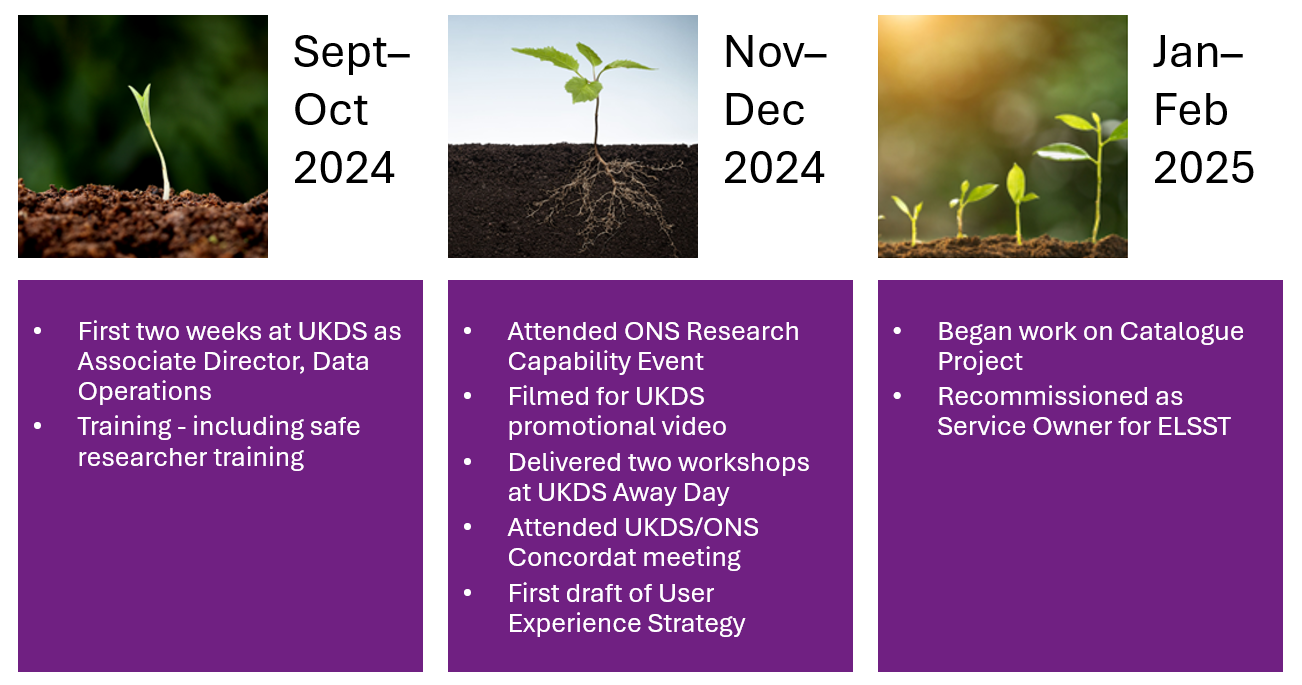
Beyond the strategy work, I’ve also enjoyed getting out and about. I attended events such as the Office for National Statistics (ONS) Research Capability event in November 2024 where amongst many others, I met Jo-Anna Hagen, who had newly been appointed as Data Governance Manager at UK Statistics Authority (UKSA). We bonded over both having Philosophy degrees in a data world that was very new to us.
I also attended fantastic conferences like IASSIST and the TRE Community Conference, as well as the DARE Secure Data Infrastructure Leaders’ Forum events. I was pleased to note that the UK Data Service is held in such high regard by others in the landscape, but regardless of the pre-eminance of our expertise and experience, each one of these events offered new ideas and plenty of inspiration to bring back home.
Another opportunity to feel proud (and a little smug) was being nominated in the “Not-for-Profit of the Year” category at the British Data Awards in July, where our Deputy Director, John Sanderson, and I attended a fabulous awards ceremony.
Figure 1 – Camilla’s Data Operation journey from September 24 – February 25
Larger version / Accessible version
Collaboration with internal and external partners
One of the highlights of the year was delivering two workshops at the UK Data Service All Staff Away Day in November – Curation and Strategic Impact and User-Centred Excellence: The Power of Strong Front-Line Services.
It was brilliant to see such lively engagement and discussion from colleagues across the Service. The day had that rare combination of being both genuinely useful and great fun, and I left feeling even more connected to everyone’s work.
Our wonderful Comms team had capitalised on my new recruit willingness and enthusiasm, so the day before the Away Day I had also agreed to take part in a promotional video for the UK Data Service. This seemed like a good idea at the time, but in the moment it felt a bit overwhelming, being only two months into the job and still not really knowing what I was talking about!
In January, we were re-funded by the Consortium of European Social Science Data Archives (CESSDA) as the Service Owner for the European Language Social Science Thesaurus (ELSST), demonstrating the ongoing trust and collaborative working with our partners at CESSDA.
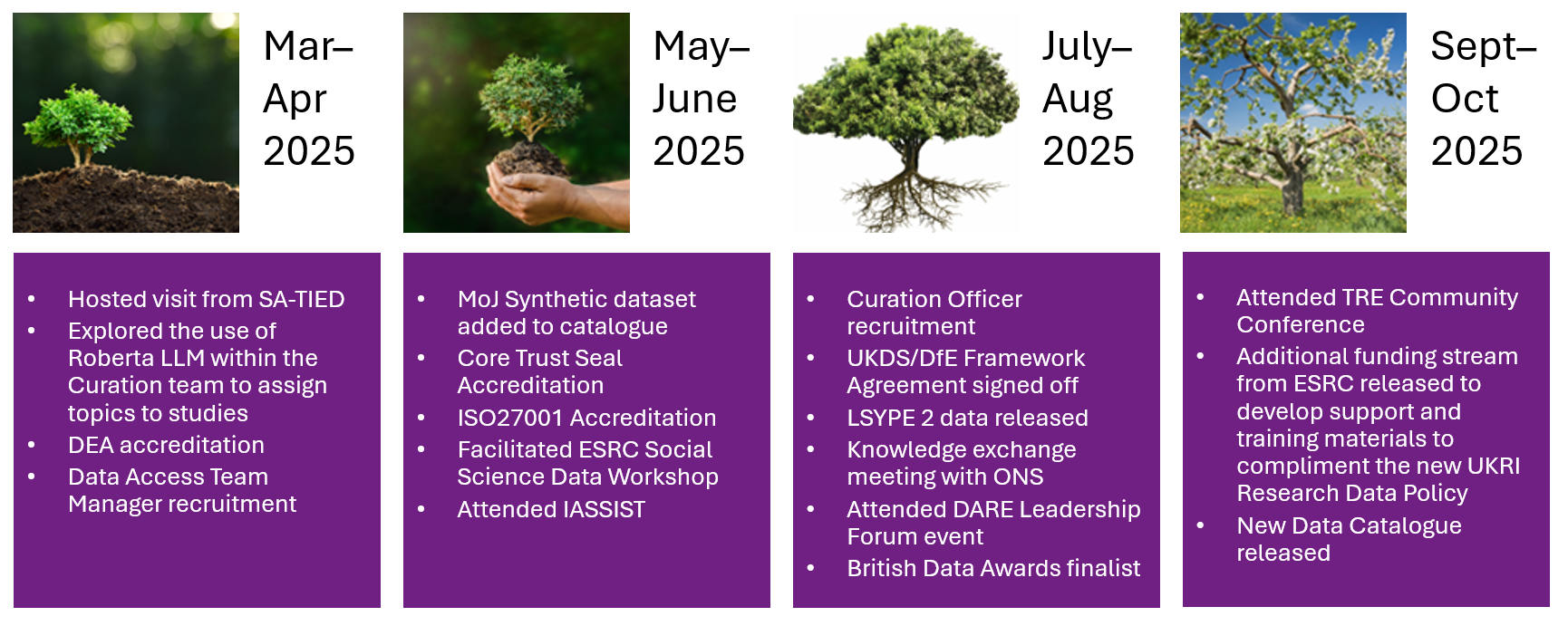
In March, I had the pleasure of hosting delegates from Southern Africa – Towards Inclusive Economic Development (SA-TIED). Their focus on supporting policymaking sparked some fascinating discussions about how we can continue to shape our services around end-user needs. It was a truly collaborative day and we’re excited to keep building on that partnership.
Also in March, the UK Statistics Authority approved the UK Data Archive’s continuing accreditation under the Digital Economy Act 2017, extending it to cover both data preparation and data provision. This was a huge team achievement and a real moment of pride (and massive thanks to Jo-Anna for making the process relatively pain-free!).
Within the Data Operations teams, we often work closely with Technical Services colleagues. We’ve been working closely with Deirdre Lungley, R&D Manager, and her team, who have been developing a Large Language Model (RoBERTa LLM) that colleagues in the Curation team are testing to see if it can assist with assigning topics to studies and potentially speed up the Curation process.
My teams were also engaged in a series of workshops that I coordinated to explore requirements for a replacement for our in-house Endeavour platform – no small task, but one full of creative ideas and practical energy.
Working with major data depositors like the Office for National Statistics (ONS), the Institute for Social and Economic Research (ISER) and the Centre for Longitudinal Studies (CLS) has been another highlight. Building and maintaining these relationships makes collaboration far more effective and often enjoyable. We hold regular meetings and with ONS we host an annual meeting to review our Concordat.
In July, Leigh Tate and Iraklis Kyritsis also arranged a knowledge exchange with ONS to explore ways of aligning processes more efficiently. I met with ONS colleagues from the Integrated Data Service (IDS) to discuss potential synergies – a reminder that “alignment” usually starts with a good conversation.
Maintaining our “street cred” and paving the way for growth
A particularly proud milestone came in July, when we finalised the Framework Agreement between UK Data Service and the Department for Education (DfE). This paved the way for wider access to educational data – with the first release, LSYPE2 (Waves 1-9), going live in August 2025.
Collaboration with our funders at the Economic and Social Research Council (ESRC) and UK Research and Innovation (UKRI) has also deepened. After Cristina Magder, our Collections Development Manager, was invited to advise UKRI on their new Research Data Policy (due to be published in early 2026), we successfully bid for additional funding to develop training and support materials for the policy. This work has included facilitating an ESRC Social Science Data Workshop, which gathered valuable feedback from across the community.
Meanwhile, the Data Access team, managed by Iraklis Kyritsis under Leigh Tate’s leadership, has been engaged in user-testing the Safe People Registry developed by Health Data Research UK (HDR UK) – an initiative that could greatly streamline researcher credential checks.
In June, the UK Data Archive achieved both Cyber Essentials Plus accreditation and renewed its CoreTrustSeal and ISO27001:2022 certifications – a triple-accreditation triumph that reflects a lot of dedication (and several celebratory biscuits at our coffee mornings).
My Collections Development Manager, Cristina Magder, has also been working on various projects to facilitate the use of synthetic data by exploring its use and governance around it.
In June the Ministry of Justice Synthetic Data First Family Court, England and Wales, 2011-2023 synthetic dataset was added to the catalogue and Cristina, who also Co-Chairs the UK Synthetic Data Community Group, published the final report on her DARE UK funded project, “User Requirements of Synthetic Data” in May.
New data catalogue!
And finally – the new Data Catalogue launched at the end of September, marking the end of a development journey that began back in 2022. It was a real joy to see it go live.
I involved a wide cross section of the UK Data Service to take part in the Catalogue Project Group and it was an absolute joy to work with so many engaged people. The project also gave me a chance to road test some of the principles of user engagement and user testing within my User Experience Strategy in a practical context.
Figure 2 – Camilla’s Data Operation journey from March 2025 – October 2025
Larger version / Accessible version
On reflection…
I am very fortunate that my role is very broad and this means I get the chance to collaborate with colleagues from across the service (I like having fingers in lots of pies – both figuratively and literally!).
My curiosity (nosiness) has also led to my involvement with the University of Essex’s “Using our expertise in AI” Steering Group, which in turn allows me to contribute to discussions within the Archive around AI strategies and policies.
Over the course of the last year, there have been a few farewells to staff who have retired or moved on but also lots of welcomes to new staff and I’m excited to see how our new recruits settle in and develop in their roles. I hope they feel as welcomed as I did when I started under the support and guidance of John Sanderson.
I have found all of the work I’ve been involved in during the last year incredibly fulfilling and interesting. I am honoured to be doing work that is important and makes a positive difference in the world. All of the achievements have been a testament to the hard work and dedication of fantastic staff at the UK Data Service and I am immensely grateful to work with such a range of talented people.
I especially want to acknowledge Cristina Magder, Data Collections Development Manager, Sharon Bolton, Data Publishing and Curation Manager and Leigh Tate, Data Access Services Manager. Without their knowledge, dedication and leadership skills, I wouldn’t have been able to write about many of the achievements above.
Looking Ahead
Members of my teams will be contributing to the SOCRATES: Scaling Output Checking, Release and Accreditation in Trusted Research Environments project, which John Sanderson is the Principal Investigator on. In addition to giving us yet another acronym to love, SOCRATES will test new ways of introducing semi-automation into the output checking process, piloting tools that can speed up disclosure checks and reduce the burden on specialist staff.
The project will assess how these approaches can be scaled to meet growing demand, ensure that compliance with UK and international standards is upheld, and improve the researcher experience by making outputs available more quickly.
We also plan to collaborate with the UK Longitudinal Linkage Collaboration (UK LLC) to share our governance frameworks and data appraisal process to assist with distributing data to the most appropriate repository.
There are also many projects underway to explore federation and interoperability between repositories and TREs, which are all very exciting and I’m looking forward to getting involved with. Here’s to future project work, collaborations and of course more acronyms! I can’t wait!
About the author
Camilla Philpot-Thomsen leads the Collections Development and Data Publishing teams at the UK Data Service and has previously worked in Higher Education since 2006, with over 14 years’ experience as a Department Manager within academic departments.
Camilla worked within the Social Sciences Faculty in the Department of Sociology and Criminology for over ten years as a senior leader, working closely with Social Science academics and students.
Camilla has a keen interest in strategic management and innovation with a focus on improving efficiency of systems and processes to enhance user experience.
Other stories you’ll find interesting
Comment or question about this blog post?
Please email us!