

We’re continuing a series of posts to mark 10 years of the UK Data Service Data Impact Fellows scheme, celebrating the many high points and looking forward to applications for the 2027-2029 cohort.
In their first post, our Director of Impact, Finn Dymond-Green, looked back at the development of the scheme. Now they pick out a few key memories.
Each time I meet with Data Impact Fellows, whether individually or as a group, I never cease to be amazed by their passion for data, for their research and for making a difference in the world.
I’ve been privileged to see collaborations, innovations and (in some fortunate cases) get to work really closely with them.
The Living Library
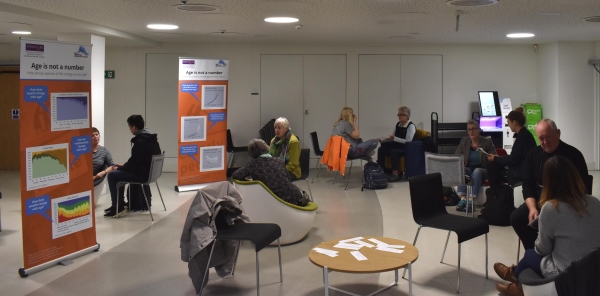
Bram and I worked together to create the Living Library for the ESRC Festival of Social Science in 2018.
Bram’s work focuses on transitions into ageing and that evidence shows that these transitions may not be as bad as people imagine. But Bram had encountered something that many ECRs face.
“One of the challenges that I was having as a young researcher working mainly with data is that very often when you mention the word statistics, people lose their interest. And I thought there must be other ways to kind of bring your research out where you can still give a message that comes from the data, but to link it with maybe [something] more intuitive, a more personal kind of approach.”
Bram and I brought together a group of trained and supported older volunteers – our ‘books’ – in a public space in Manchester Central Library.
Passers-by were encouraged to browse the book covers our volunteers had prepared with blurb about their life and to ‘borrow’ our ‘books’ for a period.
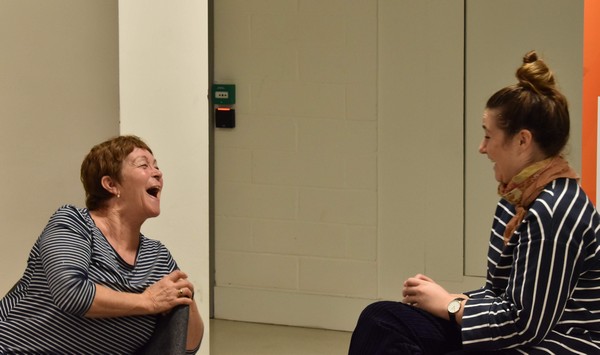
Some amazing conversations followed where experiences of ageing and transitions were uncovered in a relaxed and non-judgemental way.
Visitors were also able to peruse pop-up displays which highlighted Bram’s use of the data in his research and some key findings, with Bram on hand to explain and discuss.
The time flew by. As Bram noted,
“I think the event was a great success.
Most people did not have many issues. They wanted to talk longer than the allotted time slots. … Afterwards, many of the volunteers actually expressed interest to do it again or to continue engaging with research.”
The Changing Perceptions Challenge
Ben approached the impact team with an idea to bridge the gap between academic research into immigration and public conversations around it.
He realised that engaging younger people in approaching this gap could be a great way to encourage them to get involved in the debate, so created a competition aimed at sixth form and FE students.
The competition consisted of two parts.
The first part asked students to write a short piece of analysis that compared public and media attitudes to immigration with the latest findings of data-driven academic research.
The aim of this first part was to improve students’ understanding of the topic and prepare them for the second part of the competition, which asked students to design a campaign to communicate the research findings and improve public understanding of the economic impact of immigration.
This campaign element gave the students the chance to get creative and think about how research could make a real difference in the world.
Ben told me,
“the idea really was to try and think of a way for people to engage with a community, regardless of what that was, and make sure that the migration debate had more facts and evidence in it”
Taking place in 2021 when some of the restrictions and knock-on effects of Covid-19 were still a factor, Ben felt this was a great chance to offer a valuable extracurricular activity that teachers could use to engage their students.
Ben created a resource pack to support teachers and students in engaging with the competition activities.
He identified two key impacts the competition could create: encouraging students to think about how research can be effectively communicated to non-specialist audiences, and giving students an awareness of the fact that debates in the public eye are often more complicated than they are generally presented.
Ben continues to see the impact of the process of developing the competition in his work now:
“through the Changing Perceptions challenge […] and thinking about how you communicate quite complex topics to audiences that don’t spend their days looking at all the details and translating it into something they understand.”
Collaborators in chief
While they met before becoming Fellows, both Esmeralda and Claudia developed their collaboration while part of the scheme, organising postgraduate conferences.
Esmeralda said,
“We co-organised a conference in Nottingham. I would say about 40 speakers, probably 150 people in total attending. Without an external funder, I don’t think we would have gotten this far. I don’t think the Guardian Journalist would have agreed to be a keynote speaker. So, without the UK Data Service, I don’t think any of that would have happened.”
They also made a ‘special guest appearance’ to inspire the following cohort of Fellows.
Both Esmeralda and Claudia have been prolific contributors to the Data Impact blog.
Engaging with different audiences
I first met Christian when he presented at one of the UK Data Service’s regular user conferences, before learning more about (and joining in on) a data hacknight he organised to explore the connections between data about nutrition and greenhouse gas emissions. Christian is stilled involved in data hackathons, including this one from last year.
Christian has been involved in lots of engagement with different audiences to help understanding about food waste and healthy, sustainable eating. I particularly loved his reaction after working with a primary school audience:
“It was very humbling to have my statistics on food waste and healthy and sustainable eating quoted back to me by students from years 5 and 6, and great to know that they (and their parents) have changed behaviour due to these lessons and activities.
As I walked home that evening I reflected that it is not often that you get to see the impact of your data analysis so soon.”
Staying involved
We organised impact events with an Early Career Researcher focus in both 2024 and 2026.
It was such a pleasure to have Fellows current and previous join us at both events, presenting, being part of a panel, facilitating and engaging.

What’s next?
I’m really enjoying looking back over 10 years of the Data impact Fellows scheme (and more posts are coming!).
But I’m also looking forward.
We’ve been working to make the scheme even more beneficial to the Early Career Researchers we work with. We’ll be launching applications for the 2027 to 2029 cohort in a matter of weeks.
I can’t wait to see who will apply and who we will have the pleasure of supporting on their journey of developing approaches to engagement and impact.
About the author
Finn Dymond-Green is Director of Impact for the UK Data Service.
Before joining the UK Data Service, they worked as a primary teacher, heritage educator and consultant, e-learning developer and evaluator.
Comment or question about this blog post?
Please email us!